
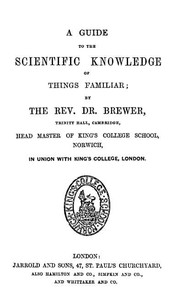
A Guide to the Scientific Knowledge of Things Familiar by Ebenezer Cobham Brewer
Let's be clear from the start: this is not a novel. There's no plot in the traditional sense. Instead, imagine a massive, wonderfully organized FAQ for the physical world, written in the 1800s. The 'story' is the journey from question to answer. Brewer structures the book as a series of simple queries—'Why does flame burn?' 'Why does a candle go out when blown upon?'—and then provides clear, detailed explanations rooted in the science of his day.
The Story
The book is built on a question-and-answer format, organized into broad sections like Heat, Air, Water, and Sound. Brewer starts with something you can observe right in your home—like dew forming on grass—and walks you backward through the science. He explains the principles of evaporation and condensation, then connects them to larger ideas about the atmosphere. He does this over and over, for everything from why sea-water is salty to why we see lightning before we hear thunder. The narrative thread is the steady unveiling of logic behind the seemingly random events of daily life.
Why You Should Read It
There's a unique charm here. First, it's a direct line to how a curious Victorian mind worked and how science was communicated to everyday people. The explanations are thorough yet avoid complex math. Second, it reawakens a basic sense of wonder. In our age of instant digital answers, we've lost the art of pondering a simple question. Brewer forces you to slow down and think deeply about causes. You'll start looking at boiling pots and rusting nails with new eyes. It's also surprisingly funny in parts, with Brewer's polite, firm tone occasionally breaking into exasperation at common superstitions he's trying to correct.
Final Verdict
This book is perfect for naturally curious people, fans of historical science, or anyone who enjoys shows like 'Connections' or 'How It's Made.' It's a fantastic bathroom book or bedside companion—perfect for short, mind-stretching reads. If you're a strict modernist who only wants up-to-the-minute science, you might find some explanations charmingly outdated. But if you want to exercise your curiosity and see the world through the eyes of a passionate 19th-century explainer, Brewer's guide is a delightful and insightful companion. It doesn't just give you facts; it teaches you how to ask better questions about everything around you.
This masterpiece is free from copyright limitations. Preserving history for future generations.
Donald Miller
1 year agoAfter a thorough walkthrough of the table of contents, the critical analysis of current industry standards is very timely. If you want to master this topic, start right here.
Mary Rodriguez
1 year agoI decided to give this a try based on a colleague's recommendation, the formatting on mobile devices is surprisingly crisp and clear. I’ll definitely be revisiting some of these chapters again soon.
Deborah Walker
3 months agoThanks for the recommendation.
David Lee
3 months agoJust what I was looking for.










Patricia Moore
3 months agoThis digital copy caught my eye due to its reputation, the narrative arc keeps the reader engaged while delivering factual content. This exceeded my expectations in almost every way.