
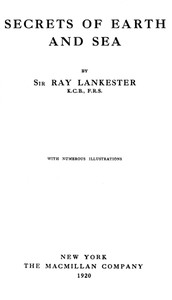
Secrets of Earth and Sea by Sir E. Ray Lankester
Let's be clear from the start: this isn't a novel. 'Secrets of Earth and Sea' is a collection of essays written by Sir E. Ray Lankester, a leading British scientist of the late 19th and early 20th centuries. He wrote these pieces for newspapers and magazines, aiming to bring the latest scientific discoveries to everyday people.
The Story
There's no traditional plot. Instead, each chapter is a deep dive into a specific natural phenomenon. Lankester picks a topic—like the migration of eels, the structure of a fly's eye, or the formation of pearls—and walks you through it. He starts with common observations or historical misunderstandings, then methodically explains the science as it was understood in his time. He acts as a guide, debunking superstitions and replacing them with evidence. You follow his line of thinking from a simple question to a detailed, often fascinating, explanation.
Why You Should Read It
I loved this book for its voice. Lankester isn't a detached observer; he's passionate and sometimes opinionated. You can feel his frustration with bad science and his joy in a clever experiment. Reading it today is a double adventure. First, you get these clear, patient explanations of nature's mechanics. Second, you get a snapshot of scientific thinking from a hundred years ago. You'll see what they got brilliantly right and where their knowledge had limits. It's a humbling reminder of how science builds on itself. The essays are short and self-contained, perfect for reading one or two before bed. They reawaken that basic sense of awe about the world right outside your window.
Final Verdict
This book is perfect for curious minds who enjoy nonfiction but hate stuffy academic writing. It's for the person who watches nature documentaries and wants more detail. History fans will appreciate the peek into Edwardian-era science communication. Because the essays are standalone, it's also great for busy readers—you can dip in and out without losing the thread. Just be ready for its age; some facts are outdated, but that's part of its charm. If you approach it as a conversation with a wise, enthusiastic scientist from the past, you'll find it absolutely rewarding.
This title is part of the public domain archive. Use this text in your own projects freely.
Michelle Ramirez
1 year agoEnjoyed every page.





Susan Lopez
1 year agoHelped me clear up some confusion on the topic.