
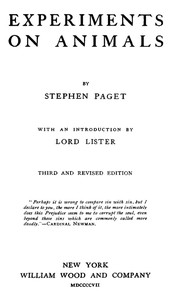
Experiments on Animals by Stephen Paget
Published in 1900, Stephen Paget's Experiments on Animals is a direct appeal for the acceptance of vivisection in medical research. Paget, a surgeon and secretary of the Research Defence Society, writes not as a philosopher, but as a practical man of science. The book is his organized defense against the growing anti-vivisection movement of his time.
The Story
There isn't a traditional plot with characters. Instead, Paget builds a case, point by point. He starts by explaining what animal experiments actually involve, trying to dispel what he sees as public misunderstanding. He then walks through the history of medicine, crediting discoveries like vaccines, antiseptic surgery, and understanding of diseases like rabies directly to work done on animals. For Paget, the chain is simple: animal experiments lead to medical knowledge, which saves human lives. He acknowledges the suffering of the animals but repeatedly weighs it against the human lives he believes are saved. The 'story' is the progression of his argument, facing down the moral objections of his critics with what he presents as irrefutable evidence of benefit.
Why You Should Read It
Reading this isn't about agreeing with Paget. In fact, I found myself mentally arguing with him on almost every page! That's the book's power. It removes the noise of our modern debate and shows you the core ethical calculation from a key moment in history. Paget's voice is utterly convinced, which makes it a perfect primary source. You see how a compassionate, educated man of his era drew a line between human and animal suffering. It's not a balanced report; it's a passionate, one-sided defense. That very bias makes it incredibly revealing. It helped me understand not just the history of science, but the history of our moral reasoning.
Final Verdict
This book is perfect for anyone interested in medical history, bioethics, or the long-running debate over animal rights. It's not an easy 'read' in terms of subject matter, but it's a short and clearly written historical document. You won't find narrative flair, but you will find a stark, unfiltered perspective. If you want to understand where today's arguments came from, start here. Just be ready to have a one-sided conversation with a very determined doctor from 1900.
This work has been identified as being free of known copyright restrictions. Share knowledge freely with the world.
Michael Sanchez
1 year agoCompatible with my e-reader, thanks.
Amanda Wright
6 months agoComprehensive and well-researched.
David Allen
1 year agoVery helpful, thanks.
Amanda Lewis
1 year agoNot bad at all.





Susan Johnson
1 year agoI took detailed notes while reading through the chapters and the case studies and practical examples provided add immense value. I'm glad I chose this over the other alternatives.