
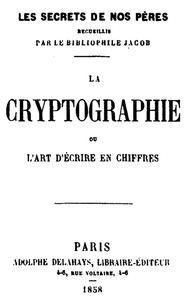
La Cryptographie, ou, l'art d'écrire en chiffres by P. L. Jacob
Let's clear something up right away: this isn't a story with a plot in the traditional sense. There's no hero's journey or villain to defeat. Instead, La Cryptographie is a guided tour through the history and methods of keeping secrets.
The Story
Think of it as a series of connected lessons. The author, P. L. Jacob, starts by explaining why secret writing matters—for war, for politics, for love. He then takes you on a trip through time. You'll see how Julius Caesar shifted letters in his messages and how medieval alchemists used strange symbols. The book breaks down different systems, from simple substitution ciphers (where one letter stands for another) to more complex codes. It's full of examples and diagrams, showing you exactly how these methods worked. The 'narrative' is the ongoing human struggle to communicate in a way only a chosen few can understand.
Why You Should Read It
What grabbed me was the sheer practicality of it. This isn't dry theory. Jacob writes with the enthusiasm of a collector showing off his favorite puzzles. You get the sense he truly loved this subject and wanted to share it. Reading it, you start to see patterns everywhere. It makes you look at old documents, or even a simple childhood code, in a new light. The book connects dots between diplomacy, warfare, and science in a way that feels very modern, despite its age. It’s a reminder that the digital privacy debates we have today are just the latest chapter in a very old story.
Final Verdict
This is a niche read, but a rewarding one. It's perfect for history buffs who enjoy the 'how' behind major events, puzzle lovers who enjoy word games and logic, and anyone with a curiosity about the roots of modern cybersecurity. If you prefer fast-paced fiction, this might feel slow. But if you like the idea of spending an afternoon unraveling the secrets of the past with a knowledgeable guide, this 19th-century manual still has a lot to say.
This masterpiece is free from copyright limitations. Knowledge should be free and accessible.
Christopher Lopez
11 months agoI found the author's tone to be very professional yet accessible, the argument presented in the middle section is particularly compelling. This adds significant depth to my understanding of the field.
John Moore
2 months agoThis work demonstrates a clear mastery of contemporary theories.
David Garcia
11 months agoA brilliant read that I finished in one sitting.
Joseph Thomas
2 months agoAfter spending a few days with this digital edition, the author doesn't just scratch the surface but goes into meaningful detail. It cleared up a lot of the confusion I had previously.
Thomas Brown
10 months agoFinally found a version that is easy on the eyes.