
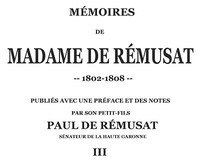
Mémoires de madame de Rémusat (3/3) by Madame de Rémusat
Claire de Rémusat’s memoirs drop us right into the heart of Napoleon Bonaparte’s imperial court, but not as generals or diplomats. We’re there as part of the furniture—the privileged, yet powerless, inner circle. As a lady-in-waiting and close confidante to Empress Josephine, Rémusat had a unique vantage point. Her story follows the arc of the Consulate and the Empire, not through decrees and treaties, but through intimate evenings, whispered anxieties, and the changing temperature of the Emperor’s moods.
The Story
There isn’t a traditional plot, but a vivid collection of scenes and character studies. We see the early, hopeful days where Napoleon’s genius charms everyone. We feel the creeping tension as his power grows absolute and his court becomes a gilded cage. The central, quiet drama is Josephine’s struggle. Rémusat shows us her warmth, her insecurity, and her frantic attempts to hold onto a husband whose eye was always on a dynasty she couldn’t give him. We witness Napoleon’s impossible demands, his sudden kindnesses, and his crushing ego. The story ends in disillusionment, with Rémusat’s own family falling from grace, offering a final, clear-eyed look at the price of proximity to power.
Why You Should Read It
You should read this because it demolishes the marble statue of Napoleon and shows you the man. Here, the great emperor is also a workaholic who neglects his wife, a perfectionist obsessed with etiquette, and a man capable of shocking pettiness. Rémusat is a brilliant observer. She doesn’t just tell us Josephine was sad; she describes the exact way her smile would falter when Napoleon entered a room with a pretty new guest. The writing feels immediate, like gossip shared over tea. You get the glitter of the jewels and the chill of the political calculations underneath. It’s history with the breath still on it.
Final Verdict
This is perfect for anyone who finds traditional history books a bit stiff. If you love character-driven novels, political dramas like Succession, or biographies that focus on the personal, you’ll be glued to this. It’s a must-read for Napoleon enthusiasts, but it’s equally compelling for readers who just love a fascinating, flawed human story. Be prepared for a dense, detailed read—it’s a memoir, not a thriller—but the payoff is an understanding of history you simply can’t get from a textbook.
Legal analysis indicates this work is in the public domain. You are welcome to share this with anyone.
Michael Jackson
7 months agoExceptional clarity on a very complex subject.
Paul Gonzalez
1 year agoThe clarity of the introduction set high expectations, and the language used is precise without being overly academic or confusing. It’s a comprehensive resource that doesn't feel bloated.
John Hernandez
1 year agoI've gone through the entire material twice now, and the emphasis on ethics and sustainability within the topic is commendable. Finally, a source that prioritizes accuracy over hype.
Michael Johnson
2 years agoLooking at the bibliography alone, the case studies and practical examples provided add immense value. Simple, effective, and authoritative – what else could you ask for?







Emily Brown
11 months agoAfter spending a few days with this digital edition, the chapter on advanced strategies offers insights I haven't seen elsewhere. It’s a comprehensive resource that doesn't feel bloated.