About 289 minutes
A Review of Edwards's "Inquiry into the Freedom of the Will" — Text and Context
Ethics
66,454 recorded words. 1 minutes difference from this book's estimate.
View Gutenberg source #35958
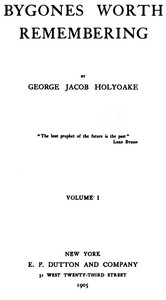
Bygones Worth Remembering, Vol. 1 (of 2) — Background and Themes can be approached with a clearer sense of reading commitment from its source measurements: 66,017 words, 4 hr 48 min estimated reading time, and 9 detected text sections.
The text analysis averages about 19.7 words per sentence, while the detected sections provide another way to judge how the source is divided.
Project Gutenberg metadata also associates the work with “Social reformers -- Great Britain -- Biography,” connecting these edition facts with the source record’s subject description.
Explore this collection
These alternatives are selected using recorded categories and estimated reading time.
About 289 minutes
Ethics
66,454 recorded words. 1 minutes difference from this book's estimate.
View Gutenberg source #35958About 298 minutes
Ethics
68,498 recorded words. 10 minutes difference from this book's estimate.
View Gutenberg source #38590About 299 minutes
Ethics
68,736 recorded words. 11 minutes difference from this book's estimate.
View Gutenberg source #30440Search stored excerpts and compare books → Choose by your preferences →
Choices use stored catalog measurements. Estimates vary with reading speed. A shared category is a catalog label, not a claim that two books have the same argument or literary quality.
Search reads excerpt text stored with this catalog and links to its associated Gutenberg record. The connection is stored in the site database; this tool does not recheck that every excerpt is word-for-word identical to that external record. Excerpt search does not cover every chapter and does not verify historical publication dates.
Catalog snapshot checked: 2026-09-26. Coverage: 94 public books, 94 available source excerpts.
Calculated from edition completeness, EPUB availability, text structure and catalogue metadata. Not a user rating.
Total of 100 points, scaled to a 2.5-5.0 range. Editions with an empty description or a missing EPUB file are not scored.
Public-domain source text
The source text is kept in the dedicated reader, separate from this catalogue record and its commentary.
Holyoake opens his preface with a declaration of principle: his aim is "to be of service to somebody" and to avoid "the Sin of Pretension." This moral earnestness, coupled with a professed allegiance to "definite, verifiable ideas," sets the tone for a volume that is part memoir, part political testament. The table of contents reveals a gallery of notable figures—George Eliot, Cobden, Mazzini, Garibaldi, John Stuart Mill—but the chapters are not conventional biographies; they are titled "Personal Incidents," "Other Instances," and "Unforeseen Qualities in Public Men," signaling an anecdotal, character-driven approach.
The excerpts show Holyoake at close quarters with his subjects: he recounts traveling to Cobden's funeral, receiving a note from the platform during Cobden's last speech, and witnessing the editor Delane's letters to Robert Lowe. These details ground the narrative in specific, often overlooked moments, inviting the reader to treat the book as a series of firsthand observations rather than a formal history.
Holyoake's preface is not a conventional apology for the book but a statement of ethical method. He defines "the Sin of Pretension" as declaring or assuming to be true what one does not know to be true—a sin he sees as pervasive in speech, morals, politics, and piety. This preoccupation with intellectual honesty shapes the entire volume. The reader should note how Holyoake applies this standard to his own subjects: he does not claim comprehensive knowledge of the figures he discusses, but rather presents incidents that illustrate character. The preface also quotes Professor Jowett's remark that "where Inquiry is denied at the door, Doubt gets in at the window," which Holyoake uses to account for his own "liberty of expression." This framing suggests the book will be candid, occasionally irreverent, and always grounded in what the author has personally witnessed or verified.
The excerpts on Richard Cobden are among the most detailed in the provided material. Holyoake relates three distinct episodes: the funeral at Trumpington, where he was the only Co-operative representative present; the quarrel with Thornton Hunt over a libelous Times article, in which Cobden's letter of self-defense was refused publication; and a story about the Central Illinois Railway giving free tickets to create a false impression of passenger traffic. Each anecdote serves a dual purpose: it reveals Cobden's character (his self-possession in speaking, his contempt for meanness) and it exposes the machinations of opponents or the press. Holyoake's tone is admiring but not hagiographic; he notes that Cobden lost a fortune by "premature enthusiasm" for international commerce. The reader should watch for how Holyoake uses small, concrete details—a note from the platform, the marks of fingers on a reputation—to build a portrait of integrity under pressure.
A recurring thread in the excerpts is the behind-the-scenes operation of the Victorian press. Holyoake describes how Times editor John Delane would send directions to Robert Lowe that "might themselves be printed as leaders in brief," and how Lowe's habit of throwing these letters into his wastebasket led to their recovery by a butterman and eventual return. This anecdote, while comic, underscores Holyoake's interest in the practical workings of power: who writes what, who suppresses what, and how reputation is managed. Similarly, the account of Thornton Hunt's refusal to print Cobden's letter reveals the tension between personal regard and editorial policy. Holyoake presents these episodes without explicit moralizing, but the cumulative effect is to show how public discourse was shaped by decisions made in private. For the reader, these passages offer a kind of x-ray of Victorian political culture, visible only because Holyoake was an insider.
The excerpts suggest that Holyoake's method is to let incidents speak for themselves, but he is not a neutral recorder. His preface declares a commitment to "verifiable ideas," and his anecdotes are chosen to illustrate principles—courage, honesty, the danger of pretension. The reader should approach each chapter as a case study in character, with Holyoake acting as a witness who was present at key moments. Because the excerpts are incomplete, we cannot know how he handles figures like Mazzini or Mill, but the pattern established with Cobden suggests a blend of personal recollection, sharp judgment, and a willingness to name names. The book's title, Bygones Worth Remembering, implies a selective memory: Holyoake preserves what he considers instructive or exemplary. Readers interested in the texture of Victorian radicalism, the cooperative movement, or the personal side of public figures will find this volume a rich, if opinionated, source.
Holyoake's volume rewards a reader who pays attention to small details—the note passed on a platform, the letter retrieved from a wastebasket, the fog on a morning journey. These are the building blocks of his method. Rather than seeking a continuous narrative, treat each chapter as a self-contained portrait, and note how Holyoake's own voice—principled, occasionally sardonic, always alert to hypocrisy—shapes the material. The book is less a history than a collection of testimonies, and its value lies in the proximity of the witness to the events he describes.
Reading Holyoake’s account of Cobden’s quiet conviction, I remembered sitting alone with that old commentary on Strauss, feeling the same patient courage in another age—men dismantling certainty, not with noise, but with the slow, unhurried weight of their questions. It left me less with answers, more with a strange, tender respect for The Life of Jesus Critically Examined (4th ed.) — A Closer Reading.
A brief reflection can help important ideas stay with you longer.