About 163 minutes
Immortality proved by the testimony of sense — A Reader’s Guide
Ethics
37,478 recorded words. 12 minutes difference from this book's estimate.
View Gutenberg source #74156
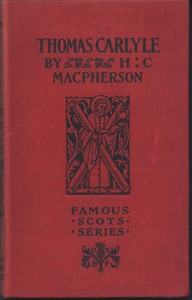
This digital edition of Thomas Carlyle — Themes and Context is described by source-level measurements including 40,049 words, 2 hr 55 min estimated reading time, and 4 detected text sections.
The text analysis averages about 23.3 words per sentence, while the detected sections provide another way to judge how the source is divided.
Project Gutenberg metadata also associates the work with “Carlyle, Thomas, 1795-1881,” connecting these edition facts with the source record’s subject description.
Explore this collection
These alternatives are selected using recorded categories and estimated reading time.
About 163 minutes
Ethics
37,478 recorded words. 12 minutes difference from this book's estimate.
View Gutenberg source #74156About 161 minutes
Ethics
36,876 recorded words. 14 minutes difference from this book's estimate.
View Gutenberg source #52984About 190 minutes
Ethics
43,662 recorded words. 15 minutes difference from this book's estimate.
View Gutenberg source #76522Search stored excerpts and compare books → Choose by your preferences →
Choices use stored catalog measurements. Estimates vary with reading speed. A shared category is a catalog label, not a claim that two books have the same argument or literary quality.
Search reads excerpt text stored with this catalog and links to its associated Gutenberg record. The connection is stored in the site database; this tool does not recheck that every excerpt is word-for-word identical to that external record. Excerpt search does not cover every chapter and does not verify historical publication dates.
Catalog snapshot checked: 2026-09-26. Coverage: 94 public books, 94 available source excerpts.
Calculated from edition completeness, EPUB availability, text structure and catalogue metadata. Not a user rating.
Total of 100 points, scaled to a 2.5-5.0 range. Editions with an empty description or a missing EPUB file are not scored.
Public-domain source text
The source text is kept in the dedicated reader, separate from this catalogue record and its commentary.
Hector Macpherson's Thomas Carlyle, published in 1897 as part of the Famous Scots Series, opens with a preface that acknowledges the crowded field of Carlyle studies. Macpherson aims to highlight the Scottish dimension of Carlyle's life while also noting his debt to German philosophy, describing Carlyle as a blend of 'German philosopher' and 'Covenanter of dyspeptic and sceptical tendencies.' The biography draws heavily on Froude's work and Carlyle's Reminiscences, with corrections from Professor Masson. The excerpts reveal a narrative that interweaves Carlyle's literary output with personal crises, such as his wife's illness and his own creative blocks, rather than offering a straightforward chronological account.
Macpherson's preface is unusually candid about his sources. He acknowledges that 'of the writing of books on Carlyle there is no end' and justifies his own contribution by the series' focus on famous Scots. He credits Froude's biography as the main foundation but notes that Froude's portrait is 'somewhat deficient in light and shade,' a deficiency he claims is remedied by Masson's Carlyle Personally, and in his Writings. Macpherson also thanks John Morley for reading proofs and expressing 'general sympathy and concurrence' with his estimate. This reliance on contemporary authorities suggests the biography is as much a synthesis of existing interpretations as an original work. The reader should note that Macpherson does not claim access to new primary sources; his method is one of distillation and emphasis on Scottish context.
The excerpts show Macpherson focusing on Carlyle's difficulties in writing, particularly his work on Cromwell. In 1842, Carlyle wrote in his journal: 'For many months there has been no writing here... I have not got one word to stand upon paper in regard to Oliver.' The biography links these creative blocks to personal tragedies: Mrs Carlyle's mother dies suddenly, and Carlyle's own health and spirits suffer. Macpherson includes vivid details, such as Carlyle having 'a room arranged for him at the top of his house' where he 'sate and smoked, and read books on Cromwell.' The narrative also highlights the death of John Sterling, whom Froude called Carlyle's 'spiritual pupil.' These passages suggest that Macpherson views Carlyle's literary output as inseparable from his emotional life, though the excerpts are too brief to show how this theme is sustained across the full biography.
Macpherson emphasizes Carlyle's moral outrage at social conditions in the 1840s. The excerpts quote Carlyle's letter to his mother: 'Eleven thousand souls in Paisley alone living on threehalfpence a day, and the governors of the land all busy shooting partridges and passing corn-laws the while!' This indignation, Macpherson suggests, drove Carlyle to interrupt his Cromwell project and write Past and Present, which appeared in April 1843. The reviewers, Macpherson notes, were divided: 'wondering, admiring, blaming, chiefly the last.' The biography presents this as a turning point, where Carlyle's sense of moral duty overrode his literary plans. However, the excerpts do not reveal whether Macpherson offers his own analysis of Past and Present or simply reports contemporary reactions. The reader should be aware that the full text may provide more context on Carlyle's social thought.
Macpherson's biography, while grounded in the work of Froude and Masson, carves out a distinct niche by foregrounding Carlyle's Scottish identity and his German philosophical influences. Readers interested in how Victorian biographers constructed national literary figures will find this volume instructive. The excerpts suggest a work that balances personal narrative with intellectual history, though the full extent of Macpherson's original analysis remains to be seen. Approach this as a document of late-Victorian biographical practice rather than a definitive life of Carlyle.
Reading about Carlyle wrestling with his pages, and his worry for his wife, I thought of an old northern proverb I once found: a king’s mirror shows not the face, but the burden. That book, The King's Mirror (Speculum regale-Konungs skuggsjá) — A Closer Reading, felt like sitting with a quiet teacher who understood that duty and loneliness often share the same chair. Carlyle’s Scotland seemed, for a moment, very close to that cold shore.
Save your reaction, strongest insight, and memorable passage.