About 341 minutes
The World Order of Bahá'u'lláh — Themes and Context
Ethics
78,333 recorded words. 9 minutes difference from this book's estimate.
View Gutenberg source #19298
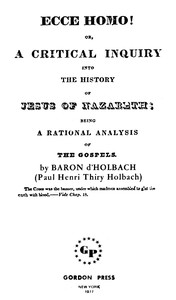
The source record for Ecce Homo! Or, A Critical Inquiry into the History of Jesus of Nazareth Being a Rational Analysis of the Gospels — Edition Insights measures this digital text at 76,294 words, 5 hr 32 min estimated reading time, and 7 detected text sections.
The text analysis averages about 25.9 words per sentence, while the detected sections provide another way to judge how the source is divided.
Project Gutenberg metadata also associates the work with “Jesus Christ -- Biography -- Early works to 1800,” connecting these edition facts with the source record’s subject description.
Explore this collection
These alternatives are selected using recorded categories and estimated reading time.
About 341 minutes
Ethics
78,333 recorded words. 9 minutes difference from this book's estimate.
View Gutenberg source #19298About 349 minutes
Ethics
80,153 recorded words. 17 minutes difference from this book's estimate.
View Gutenberg source #37744About 300 minutes
Ethics
68,791 recorded words. 32 minutes difference from this book's estimate.
View Gutenberg source #36796Search stored excerpts and compare books → Choose by your preferences →
Choices use stored catalog measurements. Estimates vary with reading speed. A shared category is a catalog label, not a claim that two books have the same argument or literary quality.
Search reads excerpt text stored with this catalog and links to its associated Gutenberg record. The connection is stored in the site database; this tool does not recheck that every excerpt is word-for-word identical to that external record. Excerpt search does not cover every chapter and does not verify historical publication dates.
Catalog snapshot checked: 2026-09-26. Coverage: 94 public books, 94 available source excerpts.
Calculated from edition completeness, EPUB availability, text structure and catalogue metadata. Not a user rating.
Total of 100 points, scaled to a 2.5-5.0 range. Editions with an empty description or a missing EPUB file are not scored.
Public-domain source text
The source text is kept in the dedicated reader, separate from this catalogue record and its commentary.
Holbach opens with a chapter on Jewish history and prophecy, immediately establishing his method: he will treat the Gospels as documents to be analyzed by reason, not as revealed truth. The table of contents reveals a systematic, nearly verse-by-verse progression through Jesus's life, from birth to resurrection, with each episode subjected to critical scrutiny. The author's preface or introduction is absent from the excerpts, but the opening chapters signal a relentless focus on contradictions, implausibilities, and the political context of first-century Judea.
The work's title, Ecce Homo!, borrowed from Pilate's presentation of Jesus, already suggests a demystifying intent: to show the man behind the divine claims. Holbach writes as a philosopher, not a theologian, addressing readers who may be skeptical of orthodox interpretations. His tone is cool, analytical, and occasionally sardonic, as when he notes that Jesus's harsh morality 'pleases the rabble, imposes on the ignorant.'
Holbach structures his book as a critical harmony of the four Gospels, following the chronological order of Jesus's ministry from birth to passion. The chapter titles—'The Birth of Jesus,' 'Baptism of Jesus,' 'Sermon on the Mount'—mirror Gospel headings, but each chapter functions as a prosecutorial brief. For instance, Chapter II examines the nativity narratives for historical plausibility, noting discrepancies between Matthew and Luke. Holbach does not merely list contradictions; he argues that the Gospel writers adapted earlier Jewish prophecies to fit Jesus, a claim he supports by quoting Old Testament passages and showing how they were reinterpreted.
The effect is cumulative: by the time the reader reaches Chapter X on the Sermon on the Mount, Holbach has already dismantled the miraculous framework. He treats parables as moral teachings that, taken literally, lead to social ruin. The structure itself is an argument: by following the Gospel sequence, Holbach forces readers to confront each episode on his rational terms, without the cushion of allegory or faith.
In Chapter X, Holbach delivers his most sustained critique of Jesus's ethical teachings. He argues that the Sermon on the Mount's precepts—turning the other cheek, renouncing wealth, loving enemies—are 'harsh' and 'proceed from insensibility.' These maxims, he claims, appeal to the 'rabble' and the ignorant, who admire rigor without practicing it. The elite, meanwhile, admire the doctrine while finding 'the secret to elude the practice' through indulgent guides.
Holbach's analysis is sociological: he contends that literal observance of Gospel morality would 'drag society into total ruin,' since society depends on self-interest, property, and self-defense. He points to the historical results—martyrs, anchorites, monks—as evidence that such teachings produce 'madmen, enemies of themselves, and perfectly useless to others.' This section reveals Holbach's Enlightenment conviction that religion must be judged by its social consequences, not its claims to divine origin.
A striking passage in Chapter X addresses the development of Christian doctrine. Holbach observes that Jesus himself 'was not acquainted with any of the dogmas which this church has since taught.' He notes that Jesus's reference to 'him who can throw both body and soul into hell' would have been unintelligible to Jews, for whom 'soul' meant blood or the animating principle. The dogma of the soul's immortality, Holbach argues, was a later addition by Platonist converts to Christianity.
This argument is characteristic of Holbach's method: he uses linguistic and historical evidence to show that core Christian beliefs evolved after Jesus's lifetime. He cites early Christian writers who spoke of God and the soul as 'material substances, more subtile indeed than ordinary bodies,' implying that later metaphysical refinements were innovations. For the first-time reader, this section is a reminder that Holbach is not merely debunking miracles but tracing the historical construction of Christian theology.
Holbach's approach demands that the reader set aside devotional assumptions and treat the Gospels as human documents. He frequently points to what the texts omit or obscure: for example, Jesus's family attempting to restrain him (Chapter XI), or the political calculations of Jewish leaders. The excerpts show Holbach attending to details that orthodox readings gloss over, such as the 'enterprize of his relations against him'—a phrase that hints at family conflict.
To follow Holbach's argument, readers should note how he uses the Gospels' own words to undermine supernatural claims. He quotes Jesus's threat of eternal punishment, then notes it 'was not contradicted in the assembly'—implying that the audience's fear was manipulated. This forensic attention to rhetoric and context is the book's chief intellectual tool. A first reading benefits from keeping a Gospel harmony at hand to compare Holbach's citations with the original texts, observing where he emphasizes discrepancies or silences.
Holbach's Ecce Homo! is best approached as a work of Enlightenment polemic, not modern historical criticism. Readers should expect a relentless, sometimes repetitive argument that treats the Gospels as evidence in a case against revealed religion. The book rewards those who read with a Bible nearby, tracking Holbach's citations and noting where his interpretations diverge from traditional ones. It is a demanding but revealing document of 18th-century radical thought, offering a window into how pre-Darwinian rationalists grappled with the foundational texts of Christianity.
Holbach’s cold dismantling of miracle stories reminded me of sitting in a library carrel, feeling the old stones of belief shift under my hands. There’s a strange relief in seeing how ideas were built. I found the same quiet ache, that patient unlacing of the divine, in The Basis of Early Christian Theism — Reading Notes, as if both books were leaving the same footprint in the dust of wonder.
A brief reflection can help important ideas stay with you longer.