About 365 minutes
The Spirit Land — Reading Companion
Ethics
83,883 recorded words. 1 minutes difference from this book's estimate.
View Gutenberg source #43237
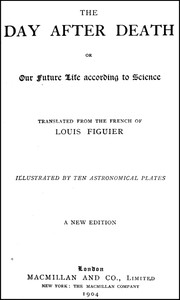
The Day After Death; Or, Our Future Life According to Science (New Edition) — Inside the Classic can be approached with a clearer sense of reading commitment from its source measurements: 84,113 words, 6 hr 6 min estimated reading time, and 10 detected text sections.
The text analysis averages about 24.3 words per sentence, while the detected sections provide another way to judge how the source is divided.
Project Gutenberg metadata also associates the work with “Cosmology,” connecting these edition facts with the source record’s subject description.
Explore this collection
These alternatives are selected using recorded categories and estimated reading time.
About 365 minutes
Ethics
83,883 recorded words. 1 minutes difference from this book's estimate.
View Gutenberg source #43237About 349 minutes
Ethics
80,153 recorded words. 17 minutes difference from this book's estimate.
View Gutenberg source #37744About 341 minutes
Ethics
78,333 recorded words. 25 minutes difference from this book's estimate.
View Gutenberg source #19298Search stored excerpts and compare books → Choose by your preferences →
Choices use stored catalog measurements. Estimates vary with reading speed. A shared category is a catalog label, not a claim that two books have the same argument or literary quality.
Search reads excerpt text stored with this catalog and links to its associated Gutenberg record. The connection is stored in the site database; this tool does not recheck that every excerpt is word-for-word identical to that external record. Excerpt search does not cover every chapter and does not verify historical publication dates.
Catalog snapshot checked: 2026-09-26. Coverage: 94 public books, 94 available source excerpts.
Calculated from edition completeness, EPUB availability, text structure and catalogue metadata. Not a user rating.
Total of 100 points, scaled to a 2.5-5.0 range. Editions with an empty description or a missing EPUB file are not scored.
Public-domain source text
The source text is kept in the dedicated reader, separate from this catalogue record and its commentary.
Louis Figuier opens The Day After Death with a bold thesis: man is the result of a triple alliance of body, soul, and life. The table of contents immediately signals a structured inquiry into what becomes of each component after death, moving from the earthly to the solar. Figuier does not merely speculate; he attempts to ground his claims in the science of his day, citing naturalists like Geoffrey St. Hilaire and Moquin Tandon. The reader is thus introduced to a work that promises to reconcile spiritual destiny with empirical observation, a project that unfolds through chapters on re-incarnation, the attributes of superhuman beings, and the physical description of the Sun.
Figuier’s method is to treat the afterlife as a subject for scientific inquiry. He draws analogies between plant and animal pathology to argue for continuity across kingdoms, stating that “a plant which passes too quickly and too often from intense cold to extreme heat, soon becomes ill, and necessarily perishes, like an animal.” This comparison serves a larger purpose: to erode the boundary between organic and spiritual life. By demonstrating that plants exhibit health, sickness, and even monstrosities—teratology applies to both kingdoms—Figuier builds a case for a universal life force that transcends death. The reader should note how he uses 19th-century biology as a scaffold for metaphysical claims, a strategy that gives his argument a veneer of objectivity.
In a striking passage, Figuier asks, “How can we admit that the being in which such changes take place, can be merely the passive subject of them, that it experiences neither pain nor pleasure?” He is referring to plants, which he argues can feel. This claim is central to his broader cosmology: if plants possess sensation, then the soul is not exclusive to humans. The excerpt details how plants suffer from diseases, old age, and death, mirroring animal life. Figuier even notes that “voluntary motion” can no longer serve as a distinguishing characteristic, citing the fly-catching plant and the oscillating plant. For the first-time reader, this section reveals Figuier’s willingness to challenge established scientific categories, preparing the ground for his later arguments about animal souls and re-incarnation.
The table of contents outlines a progression from earthly life to the Sun as the “definitive sojourn of souls.” Chapters on the physical description of the Sun and its inhabitants as “purely spiritual beings” indicate that Figuier’s science extends to astronomy. He proposes that solar rays are “emanations from spiritual beings,” a theory meant to explain the continuity of solar radiation—a problem he claims physicists cannot solve. This move from biology to astrophysics is characteristic of Figuier’s ambition: he synthesizes disparate fields into a unified narrative of the soul’s journey. Readers should watch how he uses the Sun not merely as a symbol but as a concrete location, described with astronomical plates and physical details, grounding his spiritual hierarchy in observable phenomena.
Figuier addresses the moral dimension of his system in chapters on re-incarnation. He posits that perverse souls undergo re-incarnations, while children who die in infancy follow a different path. This introduces a hierarchical afterlife where progress is possible. The excerpts do not detail the criteria for perversity or the mechanics of re-incarnation, but the structure suggests a cosmic justice system. The reader should note that Figuier’s framework is inclusive: animals and even plants participate in this migration of souls. The chapter on “What is the Animal?” and “What is the Plant?” are thus not digressions but essential components of his argument. For a first reading, these sections clarify that Figuier’s afterlife is not anthropocentric but encompasses all living beings in a grand celestial economy.
Figuier’s work is best approached as a systematic treatise rather than a devotional text. The reader should track how each chapter builds on the previous, using scientific examples to support metaphysical conclusions. Pay attention to the footnotes and references to contemporary scientists, as they reveal the intellectual context of the 1904 edition. The astronomical plates, though not reproduced here, are integral to his argument about the Sun. Approach the text with an openness to 19th-century speculative science, and you will find a coherent, if unconventional, vision of the afterlife.
Figuier’s souls, climbing from leaf to star, always struck me as patient tenants of an endless house. There is a stubborn, quiet reverence in that cosmology—a dignity in gradual ascent. I find the same unhurried seriousness in Nietzsche and Art — Text and Context, which treats creation not as a burst, but as a long, deliberate dwelling within form. Both whisper of eternity’s slow work. Odd, how they share that hush.
Your answers remain private and are stored only in this browser.