About 104 minutes
The Book of War: The Military Classic of the Far East The Articles of Suntzu; The Sayings of Wutzu — Background and Themes
Ethics
23,771 recorded words. 8 minutes difference from this book's estimate.
View Gutenberg source #44024
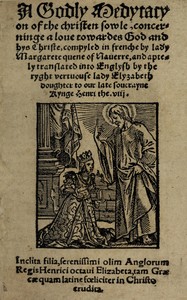
The catalog record for A godly medytacyon of the christen sowle, concerninge a loue towardes God and hys Christe — Reading Companion provides practical reading context through 22,045 words, 1 hr 36 min estimated reading time, and 10 detected text sections.
The text analysis averages about 22.2 words per sentence, while the detected sections provide another way to judge how the source is divided.
Project Gutenberg metadata also associates the work with “Devotional literature,” connecting these edition facts with the source record’s subject description.
Explore this collection
These alternatives are selected using recorded categories and estimated reading time.
About 104 minutes
Ethics
23,771 recorded words. 8 minutes difference from this book's estimate.
View Gutenberg source #44024About 85 minutes
Ethics
19,502 recorded words. 11 minutes difference from this book's estimate.
View Gutenberg source #24328About 85 minutes
Ethics
19,433 recorded words. 11 minutes difference from this book's estimate.
View Gutenberg source #30900Search stored excerpts and compare books → Choose by your preferences →
Choices use stored catalog measurements. Estimates vary with reading speed. A shared category is a catalog label, not a claim that two books have the same argument or literary quality.
Search reads excerpt text stored with this catalog and links to its associated Gutenberg record. The connection is stored in the site database; this tool does not recheck that every excerpt is word-for-word identical to that external record. Excerpt search does not cover every chapter and does not verify historical publication dates.
Catalog snapshot checked: 2026-09-26. Coverage: 94 public books, 94 available source excerpts.
Calculated from edition completeness, EPUB availability, text structure and catalogue metadata. Not a user rating.
Total of 100 points, scaled to a 2.5-5.0 range. Editions with an empty description or a missing EPUB file are not scored.
Public-domain source text
The source text is kept in the dedicated reader, separate from this catalogue record and its commentary.
This meditation, translated by the future Queen Elizabeth I when she was a young woman, presents a striking example of early Protestant devotional prose. The text is marked by a direct, intimate address to God, employing a series of paradoxes—such as calling death "swete" and "plesaunt sorowe"—that invert conventional earthly valuations. The translator's choices in diction create a voice that is at once fervent and learned, blending theological precision with emotional intensity.
The meditation repeatedly reframes death as a positive, even desirable state. The speaker declares, "I shulde call the deathe lyfe, and thys lyfe deathe," a reversal that permeates the work. Death is personified as a "myghty keye delyuerynge from all wyckednesse" and addressed as "O swete deathe, plesaunt sorowe." This language draws on Pauline theology (Romans 7, 2 Corinthians 3) but is rendered in a vernacular that makes the paradox visceral. The translator does not soften the tension; instead, she amplifies it through exclamatory rhetoric and rhythmic repetition, as in "O deathe, come, and breake the same obstacle of lyfe."
A distinctive feature of the text is its use of multiple familial roles for God: father, brother, son, and spouse. The speaker marvels, "O what vnyon is thys, syth that through faythe I am sure of the. And I maye call the, father, brother, sonne, and husbande." Each role is elaborated with a specific attribute: "Father full of humylyte, Brother hauynge our symylytude, Sone engendered through faythe, & loue, Husbande louynge, and releuynge in all extremyte." This layered address creates a dynamic relationship between the soul and the divine, shifting between hierarchy and intimacy. The translator's choice to retain the feminine pronoun for the soul ("she") reinforces the nuptial imagery.
The vocabulary of desire permeates the meditation. The soul "consumes and burnes for loue," and the speaker implores, "Lete me dye that I maye lyue with hym." The word "swetnesse" recurs, describing both the experience of hearing God's word and the union with the divine. The translator uses concrete, sensory terms—"sauoure of swetnesse," "myghty keye," "obstacle of lyfe"—to make abstract theology tangible. The repeated exclamation "O" marks moments of heightened emotion, creating a rhythm that mimics breathless longing. This diction aligns with the work's genre as a meditation, intended to move the reader affectively as well as intellectually.
John Bale's dedicatory epistle to Elizabeth frames the translation within a discourse on true nobility. He contrasts worldly claims to noble lineage—citing figures like Brute, Arthur, and William the Conqueror—with a Christian nobility based on virtue and learning. Bale's prose is dense with historical references, but his argument is clear: Elizabeth's nobility is demonstrated by her "Godly knowledge" and her labor in translating this work. This editorial choice positions the meditation as both a devotional exercise and a political statement, linking Elizabeth's piety to her royal identity. The epistle thus provides a context for the translator's voice, emphasizing that her youth and gender do not diminish her authority.
Readers approaching this text should attend to the interplay between the translator's youthful fervor and the editor's learned framing. The meditation rewards close reading of its paradoxical language and familial metaphors, which together create a distinctive devotional voice. The work stands as an example of how early English Protestantism adapted continental sources, and how a future monarch shaped her spiritual identity through translation.
That little 1548 meditation stayed with me—how Elizabeth’s translation turns intimate address into something almost breathless, like prayer folded into family talk. It reminded me of The Basis of Early Christian Theism — Reading Notes, which lingers on that same raw longing for God as nearness, not argument. Quiet book. I keep turning it over.
Your answers remain private and are stored only in this browser.