About 161 minutes
The right to be lazy, and other studies — Reading Notes
Ethics
36,876 recorded words. 2 minutes difference from this book's estimate.
View Gutenberg source #52984
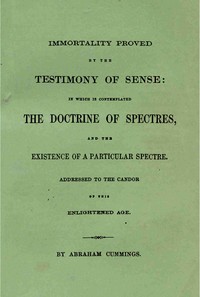
The source record for Immortality proved by the testimony of sense — A Reader’s Guide measures this digital text at 37,478 words, 2 hr 43 min estimated reading time, and 9 detected text sections.
The text analysis averages about 18.2 words per sentence, while the detected sections provide another way to judge how the source is divided.
Project Gutenberg metadata also associates the work with “Spiritualism,” connecting these edition facts with the source record’s subject description.
Explore this collection
These alternatives are selected using recorded categories and estimated reading time.
About 161 minutes
Ethics
36,876 recorded words. 2 minutes difference from this book's estimate.
View Gutenberg source #52984About 175 minutes
Ethics
40,049 recorded words. 12 minutes difference from this book's estimate.
View Gutenberg source #32626About 142 minutes
Ethics
32,489 recorded words. 21 minutes difference from this book's estimate.
View Gutenberg source #50534Search stored excerpts and compare books → Choose by your preferences →
Choices use stored catalog measurements. Estimates vary with reading speed. A shared category is a catalog label, not a claim that two books have the same argument or literary quality.
Search reads excerpt text stored with this catalog and links to its associated Gutenberg record. The connection is stored in the site database; this tool does not recheck that every excerpt is word-for-word identical to that external record. Excerpt search does not cover every chapter and does not verify historical publication dates.
Catalog snapshot checked: 2026-09-26. Coverage: 94 public books, 94 available source excerpts.
Calculated from edition completeness, EPUB availability, text structure and catalogue metadata. Not a user rating.
Total of 100 points, scaled to a 2.5-5.0 range. Editions with an empty description or a missing EPUB file are not scored.
Public-domain source text
The source text is kept in the dedicated reader, separate from this catalogue record and its commentary.
Abraham Cummings's Immortality proved by the testimony of sense opens with a direct challenge to materialism, the view that thought ceases with the body. Cummings immediately anchors his argument in a specific historical event: phenomena witnessed by hundreds in Sullivan, Maine, in 1800. The book's subtitle promises to contemplate 'the doctrine of spectres, and the existence of a particular spectre,' and the excerpts bear this out, offering a blend of philosophical reasoning and firsthand testimonies.
The narrative voice shifts between a polemical, almost sermon-like tone in the opening sections and a more documentary, procedural style in the testimonies. Cummings, a Harvard graduate and minister, presents himself as an 'eye-witness,' lending his authority to the accounts. The structure is unusual: a philosophical treatise that gives way to depositions from named individuals, complete with dates and signatures.
The opening section of the work is a sustained argument against materialism, which Cummings defines as the belief that 'all exercises of the mind are the exercises of matter.' He uses a striking analogy: 'The goose, which sometimes appears in elegant human form, we despise; while we admire the fables of Æsop and the sublime verse of that poet, who was told what is the mark of interrogation.' This rhetorical move—contrasting physical form with intellectual achievement—is typical of Cummings's method. He also invokes the 'ourang outang' to argue that anatomical similarity does not produce equal mental capacity. The language is dense and argumentative, with frequent appeals to 'facts' and 'reason.' Cummings's voice is confident, even combative, as he dismantles opposing views before presenting his own evidence.
The testimonies form the core of the book's evidence. Paul Simson, Jun., describes a controlled investigation: 'I took a candle and stood in the midst of the room. After several minutes, something rapped near where two of us stood.' The account is precise about spatial details—the knocking moves 'from thence removed to several parts of the house.' Simson's testimony includes a search of the cellar and a careful watch to ensure no living person could be responsible. The apparition appears first 'about two feet in height,' then grows 'as tall as a person' as it approaches, and finally 'diminished to about a foot in height and then vanished.' This attention to scale and movement gives the account a peculiar vividness. Sally Martin's testimony adds another layer: she describes a 'personal form, as white as any thing could possibly appear, walking by Mrs. Butler’s side, with locked arms.' The collective nature of the witnessing—'more than forty people'—is emphasized throughout.
Cummings structures the testimonies to mirror the investigative process. The narrative pace slows considerably in these sections, with detailed descriptions of movements, sounds, and spatial arrangements. For instance, Sally Martin notes that knockings occurred 'on one side or corner of the house; the next sound on the opposite side or corner, and a third sound equally distant from the second.' The repetition and measured cadence of these descriptions create a sense of methodical observation. Cummings also includes procedural instructions from the spirit itself: 'we must go up and come down again in order, two and two, and she would appear to us.' The testimonies are presented as legal depositions, with each witness signing their name. This shift from philosophical argument to quasi-legal documentation alters the reading experience, demanding patience and attention to detail. The effect is to ground the extraordinary claims in a framework of careful, communal scrutiny.
Cummings's work resists easy categorization: part philosophical treatise, part supernatural report, part legal document. Readers should attend to the shifts in register—from the abstract arguments of the opening to the concrete, almost mundane details of the testimonies. The book's value lies not in its philosophical conclusions but in its documentation of how a community grappled with the boundaries of evidence and belief. The testimonies, with their careful attention to space, sound, and movement, offer a rare glimpse into early American vernacular responses to the uncanny.
The rain kept drumming on the roof while I read about Abraham Cummings’s spectre in Maine, those careful witnesses insisting on what they’d seen. It made me think about belief, how a person clings to evidence of the unseen. Afterwards, I drifted to Thomas Carlyle — Themes and Context, and found a similar stubbornness, a different kind of insistence on what matters beyond the visible. Both left me quiet.
Save your reaction, strongest insight, and memorable passage.