About 132 minutes
The New Christianity; or, The Religion of the New Age — Inside the Classic
Ethics
30,281 recorded words. 10 minutes difference from this book's estimate.
View Gutenberg source #41559
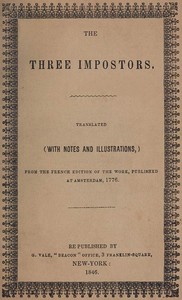
The catalog record for The Three Impostors — Text and Context provides practical reading context through 32,489 words, 2 hr 22 min estimated reading time, and 8 detected text sections.
The text analysis averages about 28.7 words per sentence, while the detected sections provide another way to judge how the source is divided.
Project Gutenberg metadata also associates the work with “Rationalism,” connecting these edition facts with the source record’s subject description.
Explore this collection
These alternatives are selected using recorded categories and estimated reading time.
About 132 minutes
Ethics
30,281 recorded words. 10 minutes difference from this book's estimate.
View Gutenberg source #41559About 123 minutes
Ethics
28,079 recorded words. 19 minutes difference from this book's estimate.
View Gutenberg source #41954About 161 minutes
Ethics
36,876 recorded words. 19 minutes difference from this book's estimate.
View Gutenberg source #52984Search stored excerpts and compare books → Choose by your preferences →
Choices use stored catalog measurements. Estimates vary with reading speed. A shared category is a catalog label, not a claim that two books have the same argument or literary quality.
Search reads excerpt text stored with this catalog and links to its associated Gutenberg record. The connection is stored in the site database; this tool does not recheck that every excerpt is word-for-word identical to that external record. Excerpt search does not cover every chapter and does not verify historical publication dates.
Catalog snapshot checked: 2026-09-26. Coverage: 94 public books, 94 available source excerpts.
Calculated from edition completeness, EPUB availability, text structure and catalogue metadata. Not a user rating.
Total of 100 points, scaled to a 2.5-5.0 range. Editions with an empty description or a missing EPUB file are not scored.
Public-domain source text
The source text is kept in the dedicated reader, separate from this catalogue record and its commentary.
The present volume opens not with a philosophical argument but with a bibliographical puzzle: a preliminary dissertation that debates whether a book called The Three Impostors was ever actually printed. The translator’s preface frames the work as a vindication of private judgment, while the British publisher calls it “an excellent antidote to Superstition and Intolerance.” This layered framing—publisher’s note, translator’s preface, then a series of disquisitions—immediately signals that the text is as much about its own contested history as about its stated subject. The reader is asked to navigate multiple voices: the German scholar who believed the book existed, the French critic M. de la Monnoye who refuted that claim, and the anonymous translator who presents the whole as a contribution to religious liberty.
The catalog lists five dubious authors—Jean Maximilien Lucas, Peter Friedrich Arpe, Jean Aymon, Bernard de La Monnoye, and Jean Rousset de Missy—along with a sixth name, Jan Vroese, in the metadata. This uncertainty is not incidental; it is the subject of the opening disquisitions. The text reproduces a letter by M. de la Monnoye that argues the book never existed, and an answer to that dissertation. The reader encounters a work that is partly a scholarly debate about its own provenance. The shifting attributions reflect the clandestine circulation of radical ideas in early modern Europe, where authorship was often concealed or misattributed. The preliminary matter thus functions as both introduction and evidence, making the book’s contested history part of its argument.
Once past the preliminaries, the treatise adopts a methodical, almost clinical tone. Section §6 describes how “ambitious men, intoxicated with the pleasure of being elevated above their fellow mortals, attempted to add to their reputation by feigning that they were the friends of those invisible Beings.” The prose proceeds by accumulation: a list of deified natural phenomena, animals, and abstractions—Time, Day, Night, Victory, Strife—each item adding weight to the claim that religion is a human invention. The repetition of “they” and “every” creates a rhythm of exposure. The author does not argue so much as catalogue, implying that the sheer multiplicity of invented deities is itself proof of imposture. This enumerative style, reminiscent of Enlightenment catalogues of superstition, drives the argument forward without relying on narrative or anecdote.
The treatise’s pace is deliberate and repetitive, building its case through parallel structures. Section §7 lists gods of “the Heavens, the Earth, the Sea, Fire, the Winds and Planets,” then adds men, women, birds, reptiles, and plants. The effect is cumulative: each sentence adds another category, another example, until the reader is overwhelmed by the sheer number of invented deities. The pace quickens in §8, where the author moves from listing to explaining how priests “pretended to be divinely inspired Prophets” and established oracles at Delos and Delphi. The shift from enumeration to causal explanation marks a change in rhetorical gear, but the underlying method remains the same: expose the mechanism behind the belief. The final sentence of §8—“ignorance will receive any impression, when men know how to take advantage of it”—caps the section with a general principle, slowing the pace for reflection before the next wave of examples.
Readers approaching The Three Impostors should attend to its layered structure: the preliminary disquisitions are not mere preface but integral to the work’s meaning. The text rewards attention to its rhetorical patterns—the lists, the repeated syntactic frames, the shifts from catalogue to explanation. Because the excerpts are incomplete, the full argument of the treatise remains unclear, but its method is evident: it proceeds not by narrative or dialogue but by systematic accumulation of examples, each one chipping away at the authority of established religion. The book is best read as a performance of Enlightenment critique, where the form of the argument is as telling as its content.
Flipping through The Three Impostors again, I kept thinking of its careful dismantling of certainty, the way it pulls a legend apart thread by thread. And then, unexpectedly, I wanted that other volume’s quiet, credulous warmth beside it—The Spirit Land — Reading Companion—the two of them like old friends arguing gently across a table, one doubting, one believing, both whispering about things unseen.
Answer a few questions and save a private reflection on this device.