About 114 minutes
The Mirror of Alchimy — A Closer Reading
Ethics
26,159 recorded words. 3 minutes difference from this book's estimate.
View Gutenberg source #58393
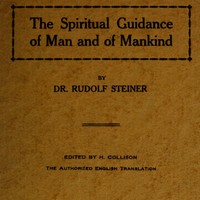
Before opening The Spiritual Guidance of Man and of Mankind — A Closer Reading, the edition data offers a quick orientation: 25,350 words, 1 hr 51 min estimated reading time, and 3 detected text sections.
The text analysis averages about 27.2 words per sentence, while the detected sections provide another way to judge how the source is divided.
Project Gutenberg metadata also associates the work with “Anthroposophy,” connecting these edition facts with the source record’s subject description.
Explore this collection
These alternatives are selected using recorded categories and estimated reading time.
About 114 minutes
Ethics
26,159 recorded words. 3 minutes difference from this book's estimate.
View Gutenberg source #58393About 117 minutes
Ethics
26,733 recorded words. 6 minutes difference from this book's estimate.
View Gutenberg source #66820About 104 minutes
Ethics
23,771 recorded words. 7 minutes difference from this book's estimate.
View Gutenberg source #44024Search stored excerpts and compare books → Choose by your preferences →
Choices use stored catalog measurements. Estimates vary with reading speed. A shared category is a catalog label, not a claim that two books have the same argument or literary quality.
Search reads excerpt text stored with this catalog and links to its associated Gutenberg record. The connection is stored in the site database; this tool does not recheck that every excerpt is word-for-word identical to that external record. Excerpt search does not cover every chapter and does not verify historical publication dates.
Catalog snapshot checked: 2026-09-26. Coverage: 94 public books, 94 available source excerpts.
Calculated from edition completeness, EPUB availability, text structure and catalogue metadata. Not a user rating.
Total of 100 points, scaled to a 2.5-5.0 range. Editions with an empty description or a missing EPUB file are not scored.
Public-domain source text
The source text is kept in the dedicated reader, separate from this catalogue record and its commentary.
Rudolf Steiner opens these lectures by asking readers to reflect on a 'second and more powerful self' within, one that initially appears lower than the conscious soul but reveals deeper guidance through life review. The text, based on talks given in Copenhagen in June 1911, assumes familiarity with Steiner's earlier works Theosophy and An Outline of Occult Science. Steiner notes he has rewritten the shorthand report while preserving 'the character given in oral delivery,' a deliberate stylistic choice he normally avoids. The result is a work that retains the rhythm of spoken address, with recurring phrases like 'it turns out' and 'if we ask ourselves' that invite the reader into a process of self-examination.
Steiner explicitly states he has 'completely re-written the shorthand report' yet aimed to 'preserve the character given in oral delivery.' This is unusual for him, as he generally believes 'the form of work intended for reading should be quite different from that used in speaking.' The lectures thus carry a hybrid quality: they are polished for print but retain rhetorical markers of live speech. Phrases such as 'a man reflecting on his own nature soon becomes conscious' and 'if we often, in the course of our lives, make a kind of survey' create a direct, almost conversational tone. Steiner uses second-person address sparingly but effectively, drawing the reader into a shared inquiry. The text's structure—short paragraphs, repeated conditional clauses ('if we ask ourselves,' 'if a wise Providence had not allowed')—mirrors the incremental unfolding of an argument designed for an audience listening in real time.
Steiner's vocabulary consistently distinguishes between levels of spiritual beings. He refers to 'Luciferic beings of the lowest stage,' 'normally progressive beings,' and those who 'lag behind' in evolution. The term 'lag behind' recurs, describing forces from the Egypto-Chaldæic period that 'would normally have completed their evolution' but were deliberately left to influence modern materialistic thought. Steiner avoids abstract labels; instead, he grounds these beings in historical epochs: Egyptian embalming practices, Chaldæic science. He writes that 'the modern anatomist dissects what he sees' and that in modern science 'there are living the forces of the ancient Egyptian and Chaldæic world.' This diction ties cosmic hierarchy to observable cultural phenomena, making the invisible tangible through concrete historical examples.
Steiner argues that certain beings 'fell short in their evolution' during the Egypto-Chaldæic period, and this lag serves a purpose: without it, contemporary civilization would lack 'necessary weight.' These forces direct attention to physical life, enabling achievements in 'technique, industries, etc.' But they also carry danger: if unrecognized, they foster materialism that denies the spiritual. Steiner contrasts this with the opposite extreme—forces that would 'bring man into the spiritual world by main force,' leading to dreaminess and contempt for the material. He warns that 'wild and fanatical advocacy of the noblest impulses may bring about the worst of results.' The balance, he insists, requires that people 'strive after the highest modestly and sensibly.' This section reveals Steiner's dialectical method: each evolutionary stage involves a necessary tension between progressive and retarding influences.
Steiner asserts that 'clairvoyant vision is able to trace the co-operation of both classes of beings in the supersensible world.' He distinguishes between merely opening 'spiritual eyes and ears' through exercise—which only allows one to 'see what is there'—and truly comprehending spiritual events as manifestations behind physical facts. The text implies that understanding cosmic events requires more than perception; it demands interpretation of how 'physical facts surrounding humanity' are expressions of supersensible activity. Steiner's phrasing here is careful: he does not claim that clairvoyance alone suffices, but that it must be combined with a framework that recognizes the interplay of progressive and lagging beings. This epistemological caution reflects the lectures' intended audience, already acquainted with occult science, and underscores Steiner's emphasis on method over mere vision.
Readers unfamiliar with Steiner's foundational works may find the lectures' premises challenging; the preface itself warns that without knowledge of Theosophy and An Outline of Occult Science, the text 'must needs appear the strange outpouring of mere fancy.' Approaching the lectures as a spoken argument—with its repetitions, rhetorical questions, and incremental logic—can help. Pay attention to how Steiner uses historical examples not as proof but as illustrations of cosmic principles. The text rewards careful attention to his diction of hierarchy and delay.
Rereading Steiner’s Copenhagen lectures, I kept thinking about the long shadows of Augustine’s earthly city—how each author wrestles with the slow pull of invisible forces through ordinary time. There’s a quiet comfort in that shared uncertainty, like two old friends describing the same dusk from different windows. The City of God, Volume II — Context and Discussion felt less like a book and more like that same twilight, patient and unhurried.
Save your reaction, strongest insight, and memorable passage.