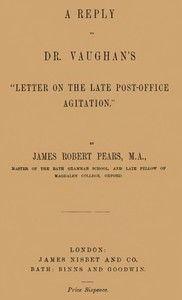
A Reply to Dr. Vaughan's "Letter on the Late Post-Office Agitation" — Themes and Context

(0 User reviews)   321
In Category - Ethics
Pears, James Roberts Project Gutenberg 2020 Not confirmed
Postal service -- Great Britain; Sunday legislation -- Great Britain; Vaughan, C. J. (Charles John), 1816-1897. Letter on the late Post-Office agitation Readers of public-domain and historical texts
Project Gutenberg digital edition en

Edition facts

Words 8,494
Reading time 37 min
Text sections 1

A Reply to Dr. Vaughan's "Letter on the Late Post-Office Agitation" — Themes and Context can be approached with a clearer sense of reading commitment from its source measurements: 8,494 words, 37 min estimated reading time, and 1 detected text section.

The text analysis averages about 26.3 words per sentence, while the detected sections provide another way to judge how the source is divided.

Project Gutenberg metadata also associates the work with “Postal service -- Great Britain,” connecting these edition facts with the source record’s subject description.

A pointed 1850 rebuttal to Dr. Vaughan's defense of Sunday postal work, exposing rhetorical evasions and the political pressures behind a contested Post Office minute.
Share
Editorial Edition Score 4.3/5

Calculated from edition completeness, EPUB availability, text structure and catalogue metadata. Not a user rating.

How this score is calculated
  • Description quality20 pts
  • Title & short description10 pts
  • Source metadata20 pts
  • Text length15 pts
  • Chapters / structure15 pts
  • EPUB file integrity20 pts

Total of 100 points, scaled to a 2.5-5.0 range. Editions with an empty description or a missing EPUB file are not scored.

Edition quality

Read the Text

ended for years? Who told you that we dared impiously to resist any act of obedience to the Lord? Nothing could be further from my mind. Many of us, as I can venture to assert, whether right or wrong in our judgment, have a clear, defined, invariable rule of obedience to the will of God, by which we desire to be guided, and desire others also to be ruled, as the best wish we can express for them.

It is impossible from your letter to conjecture what may be your view of the ordinance of the Lord’s-day. You have indeed told us in another place, in sufficiently general terms, that “without that ordinance, indeed, without that weekly memento, visible in all things around us, of realities unseen but eternal, no other memorial of God’s love could, in a world like ours, find room and scope for its operations.” {11} But this does not supply the want. I cannot conjecture whether you look upon the observance of that day as enforced by command, or instituted as a privilege, or appointed as a type, or a mere human institution. I reject the latter supposition as impossible, for I cannot suspect a minister of our church of the base hypocrisy of using her services while he holds the Lord’s-day to be merely of man. You therefore think that, in one way or other, it has a Divine sanction, and is a part of the Divine purpose. The Word of the Spirit appears to give great latitude upon the subject, when we read, “One man esteemeth one day above another, another esteemeth every day alike.” But we must read on, “Let every man be fully persuaded in his own mind.” Yes, Sir, we have surely a right to expect from a teacher of Divine Truth a clear expression of _the full persuasion_ of his own mind, when he publicly treats on such a subject.

There is nothing which irritates an earnest, intelligent mind more than a weak exhibition of moral duties upon untenable grounds, or by unsound arguments. It is possible that a vague outcry upon the subject of the Post Office desecration of the Lord’s-day may have provoked you to make and print the inconsiderate reply, which is now before me. And all who esteem your reputation will regret that any outcry, however vague and unreasonable, should have drawn from an instructed mind a reply without one single definite statement of truth, or of duty. You must pardon me, therefore, if I state for you a few positions, which you certainly do hold in common with myself.

You will not hesitate to assert,

I. That no combination of circumstances can possibly make it right to do that which is evil in the sight of God.

The contrary supposition necessarily asserts imperfection in His mind, or His government.

II. That our obedience to His will is no obedience, unless it be in spirit and in truth, without even a desire for evasion.

III. That each human being shall exist to eternity, in the blessedness of the kingdom of Christ, or in the misery of the damned.

IV. That they shall perish eternally who know not God, and obey not the Gospel of the Lord Jesus Christ.

V. That God has mysteriously connected deliverance from eternal death with the hearing of the Gospel.

VI. That He has likewise connected obedience to His will, and His own glory in His people, with the knowledge of His word.

VII. That it is of _infinite_ importance that every man should hear the Gospel, which is the power of God unto salvation to them that believe.

VIII. That the Lord’s-day is especially set apart, under Divine sanction, for the hearing of the word, and for the turning the mind of men from the things of the world to God.

IX. That it is better for “sixty thousand letters” to be burned, unopened, than for one Post Office Clerk to perish in hell for ever.

I can venture, Sir, to tell the world that your mind is quite made up on all these points. And the world will wonder that you should hitherto have failed to use all your faculties and influence for the deliverance of those poor men, whom the requirements of a godless or thoughtless multitude have shut up in the Post Office from the sound of the Gospel.

James Roberts Pears opens his reply to Dr. Vaughan with a striking contrast: the same arguments that seemed pardonable when voiced by a legislator like Grantley F. Berkeley become intolerable when echoed by a clergyman and educator. The pamphlet is built around this tension—between the expected moral authority of a preacher and the actual content of his defense of Sunday labor. Pears repeatedly accuses Vaughan of ignoring the settled terms of the debate, of repeating initial questions as if no progress had been made. The tone is one of weary but sharp correction, aimed at an opponent who, in Pears's view, has forfeited the right to be treated as a novice.

The Rhetoric of Evasion

The accusation of evasion is reinforced by Pears's handling of the Post Office minute. He dismisses the claim that it was a “spontaneous act of piety,” instead calling it “the evasive reply to the urgent and often repeated remonstrances of tens of thousands of thoughtful Christian men.” The minute, in his reading, is not a concession but a tactical maneuver, designed to appear conciliatory while preserving the essential structure of Sunday labor. Pears's language here is deliberately deflationary: he speaks of “pretty simplicity” and “curious preface,” undermining the official narrative with a tone of ironic exposure.

The Closed Office as Unanswerable Argument

The logic is precise: if the London office had always been closed, then any Sunday work there is an innovation, not a continuation. Pears uses this to invert Vaughan's framing, turning what might seem like a moderate reform into a fresh violation. He also cites the Latin tag “Principiis obsta” (resist beginnings) to argue that this is precisely the moment to oppose the practice, before it becomes entrenched. The pamphlet thus operates on two levels: a factual dispute about what the Post Office actually did, and a moral argument about the duty to resist incremental encroachments on the Sabbath.

The Politics of Pressure and Prestige

He also draws attention to the class dimensions of the issue. The Sunday money-order business, he writes, was “an insult on a Christian community” because “when every bank and office was closed, and a respectable tradesman would have been ashamed to look for gain on the Lord's-day, the one place open in every town for petty traffic should be the Government office of the British Empire.” The phrase “petty traffic” is chosen to diminish the official justification, while the reference to “respectable tradesman” invokes a standard of propriety that the government itself is failing to meet. Pears thus turns the charge of impropriety back onto the authorities, accusing them of setting a worse example than the tradesmen they might claim to regulate.

Readers should attend to Pears's method of argument: he does not merely assert a position but dissects his opponent's language, exposing what he sees as evasions, misdirections, and failures of logic. The pamphlet is a model of polemical close reading, grounded in a specific historical moment—the 1850 Post Office agitation—but also illustrative of broader tensions between religious conviction, political pressure, and bureaucratic inertia. The excerpts are sufficient to trace Pears's rhetorical strategy, though the full text would reveal whether his confidence in the settled nature of the debate was justified by subsequent events.

Reading this 1850 rebuttal, I recalled sitting in my grandfather's study, watching him argue with a newspaper editorial—not about Sunday mail, but about faith's quiet stubbornness. That same feeling of measured resistance surfaced later in Theism and Humanism Being the Gifford Lectures Delivered at the University of Glasgow, 1914 — Reading Notes, where careful reason meets something deeper than logic, and I felt, again, that achingly human pull between principle and convenience.

There are no reviews for this eBook.

0
0 out of 5 (0 User reviews )

Add a Review

Your Rating *
There are no comments for this eBook.

Reader reflection

How will you remember this book?

Save your reaction, strongest insight, and memorable passage.

Your progress 0 / 10
1

What is your current status with this title?

2

What was your overall reaction to the book?

3

Is this a title you would suggest to others?

4

How easy was the book to follow?

Related eBooks