About 129 minutes
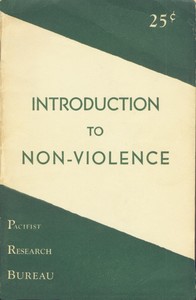
Introduction to Non-Violence — Context and Discussion
Political Philosophy
29,520 recorded words. 4 minutes difference from this book's estimate.
View Gutenberg source #18493
For Absurdities of immaterialism — Edition Insights, the stored edition analysis reports 28,740 words, 2 hr 5 min estimated reading time, and 3 detected text sections.
The text analysis averages about 23.4 words per sentence, while the detected sections provide another way to judge how the source is divided.
Project Gutenberg metadata also associates the work with “Latter Day Saint churches -- Controversial literature,” connecting these edition facts with the source record’s subject description.
Explore this collection
These alternatives are selected using recorded categories and estimated reading time.
About 129 minutes
Political Philosophy
29,520 recorded words. 4 minutes difference from this book's estimate.
View Gutenberg source #18493About 96 minutes
Political Philosophy
21,863 recorded words. 29 minutes difference from this book's estimate.
View Gutenberg source #61807About 87 minutes
Political Philosophy
19,894 recorded words. 38 minutes difference from this book's estimate.
View Gutenberg source #38107Search stored excerpts and compare books → Choose by your preferences →
Choices use stored catalog measurements. Estimates vary with reading speed. A shared category is a catalog label, not a claim that two books have the same argument or literary quality.
Search reads excerpt text stored with this catalog and links to its associated Gutenberg record. The connection is stored in the site database; this tool does not recheck that every excerpt is word-for-word identical to that external record. Excerpt search does not cover every chapter and does not verify historical publication dates.
Catalog snapshot checked: 2026-09-26. Coverage: 94 public books, 94 available source excerpts.
Calculated from edition completeness, EPUB availability, text structure and catalogue metadata. Not a user rating.
Total of 100 points, scaled to a 2.5-5.0 range. Editions with an empty description or a missing EPUB file are not scored.
Public-domain source text
The source text is kept in the dedicated reader, separate from this catalogue record and its commentary.
Orson Pratt, an apostle of the Church of Jesus Christ of Latter-day Saints, wrote Absurdities of Immaterialism in 1852 as a direct reply to T. W. P. Taylder's pamphlet The Materialism of the Mormons or Latter-day Saints, Examined and Exposed. The catalog lists this work under 'Latter Day Saint churches -- Controversial literature,' and the excerpts confirm a combative, philosophical tone. Pratt opens by challenging Taylder's claim that the question 'What is truth?' was unanswerable before the New Testament, asserting instead that basic truths—like 'space is boundless'—are self-evident and independent of scripture. This sets up a defense of materialism, the doctrine that all existence, including mind and spirit, is material.
Pratt begins by dismantling Taylder's assertion that the New Testament uniquely answers 'What is truth?' He argues that truth exists independently of human ideas or divine revelation. For example, he states, 'It is a truth that something exists in space,' and that geometric truths like 'the three angles of a triangle are equal to two right angles' were known before the Bible. He criticizes Dr. Good's definition that truth is 'the connexion and agreement, or repugnancy and disagreement, of our ideas,' calling it erroneous because truth is independent of ideas. Pratt insists that even if neither the universe nor God existed, 'eternal, unchangeable, and necessary truths' like boundless space and endless duration would still exist. This philosophical move establishes a foundation for materialism: if truth is material or grounded in material reality, then immaterialism (the belief in non-material spirit or mind) is logically flawed.
Pratt engages with several philosophers to expose what he sees as absurdities in immaterialism. He references Hobbes, Spinoza, Priestley, and Darwin (Erasmus, likely) as materialists who wrongly thought thought and feeling arise from organized matter. He then turns to Dr. Brown, who argued that a system of particles cannot have properties not possessed by individual particles. Pratt agrees with Brown on this point, but criticizes Brown for then supposing 'an individual unity to be inconsistent with extension and parts,' which Pratt calls 'an absurdity still more glaring.' He also mocks the idea that thought could be 'little particles of matter,' using Brown's own reductio ad absurdum: 'the twentieth part of an affirmation, or the quarter of a hope' is as nonsensical as 'the north and east corners of a comparison.' Pratt's method is to use logical consistency to defend a materialist view of mind.
The excerpts show a clear structure: Pratt quotes Taylder, then systematically refutes each point using logic, geometry, and appeals to common sense. He often poses rhetorical questions, such as 'What does this author mean by the foregoing assertions?' to guide the reader. The text is dense with philosophical references, but Pratt avoids technical jargon, aiming for a broad audience. He also uses analogies, like comparing thought to geometric figures, to make his arguments concrete. Notably, the excerpts do not include any narrative or historical context about Mormonism itself; the focus is entirely on metaphysical debate. This suggests that the book is a polemical work intended to defend Latter-day Saint materialism against Protestant critiques, rather than a doctrinal exposition.
Readers should approach Absurdities of Immaterialism as a period piece of religious-philosophical controversy. Pratt's arguments are rooted in 19th-century metaphysics and may seem dated, but they reveal how early Mormon intellectuals engaged with broader philosophical currents. The text rewards careful attention to its logical structure and use of sources, though it assumes familiarity with the works of Priestley, Brown, and others. For those interested in the intersection of religion and philosophy, this pamphlet offers a unique window into a forgotten debate.
That rainy afternoon, Pratt’s stubborn geometry softened into something stranger—his insistence that even truth has weight left me porous. Later, staring at the window’s drips, I reached for Introduction to Non-Violence — Context and Discussion Introduction to Non-Violence — Context and Discussion, and found the same quiet firmness, only turned toward gentleness. One book’s walls became another’s doorway.
Save your reaction, strongest insight, and memorable passage.