About 125 minutes
Absurdities of immaterialism — Edition Insights
Political Philosophy
28,740 recorded words. 4 minutes difference from this book's estimate.
View Gutenberg source #45005
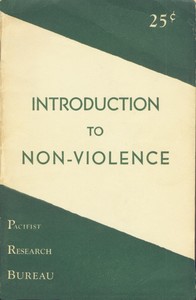
The catalog record for Introduction to Non-Violence — Context and Discussion provides practical reading context through 29,520 words, 2 hr 9 min estimated reading time, and 5 detected text sections.
The text analysis averages about 23.4 words per sentence, while the detected sections provide another way to judge how the source is divided.
Project Gutenberg metadata also associates the work with “War,” connecting these edition facts with the source record’s subject description.
Explore this collection
These alternatives are selected using recorded categories and estimated reading time.
About 125 minutes
Political Philosophy
28,740 recorded words. 4 minutes difference from this book's estimate.
View Gutenberg source #45005About 96 minutes
Political Philosophy
21,863 recorded words. 33 minutes difference from this book's estimate.
View Gutenberg source #61807About 169 minutes
Political Philosophy
38,790 recorded words. 40 minutes difference from this book's estimate.
View Gutenberg source #43548Search stored excerpts and compare books → Choose by your preferences →
Choices use stored catalog measurements. Estimates vary with reading speed. A shared category is a catalog label, not a claim that two books have the same argument or literary quality.
Search reads excerpt text stored with this catalog and links to its associated Gutenberg record. The connection is stored in the site database; this tool does not recheck that every excerpt is word-for-word identical to that external record. Excerpt search does not cover every chapter and does not verify historical publication dates.
Catalog snapshot checked: 2026-09-26. Coverage: 94 public books, 94 available source excerpts.
Calculated from edition completeness, EPUB availability, text structure and catalogue metadata. Not a user rating.
Total of 100 points, scaled to a 2.5-5.0 range. Editions with an empty description or a missing EPUB file are not scored.
Public-domain source text
The source text is kept in the dedicated reader, separate from this catalogue record and its commentary.
Theodore Paullin's Introduction to Non-Violence, published in 1944 by the Pacifist Research Bureau, opens with a pointed epigraph from Lewis Carroll's Humpty Dumpty: words mean what the speaker chooses them to mean. This sets the stage for a work that is fundamentally about terminology and classification. Paullin does not simply advocate for non-violence; he dissects it, distinguishing between non-violent coercion, satyagraha, non-resistance, and active goodwill. The book's structure—eight chapters moving from definitions through historical examples to conclusions—reflects a systematic effort to bring clarity to a concept often muddied by imprecise usage.
Paullin's central contribution is his classification of non-violent action into distinct types. He devotes separate chapters to non-violence by necessity, non-violent coercion, satyagraha, non-resistance, and active goodwill. Each category is illustrated with historical cases: Chinese boycotts, Egyptian opposition to Great Britain, the American abolition movement, and Mennonite practices. The taxonomy is not merely descriptive; it serves to highlight differences in underlying philosophy and method. For instance, satyagraha, as practiced by Gandhi, is presented as a proactive, truth-seeking force, while non-resistance, as seen in Mennonite tradition, is a principled refusal to engage in conflict. This structural choice allows Paullin to compare and contrast approaches without conflating them.
The excerpts reveal a pattern of movement between specific, concrete episodes and broader analytical claims. Paullin recounts Gandhi's 1893 coach journey in South Africa, where he was beaten for refusing to sit on the footboard, and his later refusal to prosecute a mob that attacked him. These personal anecdotes are followed by the Ahmedabad mill strike, where Gandhi's fast emerged spontaneously. The narrative shifts from the intimate—a coachman boxing ears—to the collective—a strike of mill workers. This movement between scales is characteristic of Paullin's method: he uses vivid incidents to illustrate principles, then steps back to discuss their implications for non-violent theory. The reader is constantly moved between the particular and the general.
A recurring image in the excerpts is the acceptance of suffering as a transformative force. Paullin notes that Gandhi's refusal to prosecute his attackers 'aroused a favorable reaction on the part of the public,' and that the principle developed that 'the acceptance of suffering was an effective method of winning sympathy.' This image recurs in the Kheda Satyagraha, where Gandhi discovered that 'when the fear of jail disappears, repression puts heart into people.' The oppressor's power, Paullin argues, depends on the victim's fear. By enduring suffering without retaliation, the non-violent actor shifts the moral balance. This image of suffering as a lever appears repeatedly, linking diverse cases from South Africa to India.
Paullin emphasizes that Gandhi's methods were not derived from abstract theory but from empirical experience. He writes that Gandhi 'arrived empirically at many of his specific techniques,' citing the coach incident and the Ahmedabad fast. This focus on empirical origins is a structural feature of the book: Paullin grounds his analysis in documented events rather than philosophical speculation. The excerpts show him drawing on Gandhi's autobiography and other primary sources to trace how ideas emerged from practical struggles. This approach gives the work a concrete, historical texture, even as it aims to categorize and generalize. The reader is invited to see non-violence not as a fixed doctrine but as a set of practices refined through trial and error.
Paullin's Introduction to Non-Violence rewards readers who attend to its structure and recurring motifs. The movement between personal narrative and analytical framework, the emphasis on empirical origins, and the careful taxonomy all contribute to a work that is both a historical survey and a conceptual clarification. Readers should approach it as a mid-century attempt to bring order to a contested field, noting how the categories Paullin establishes continue to inform discussions of non-violent action today.
Paullin’s book felt like a quiet catalog of human restraint, each case a patient unfolding of pressure and release. Reading it, I remembered how the other volume asks us to look for hidden rhythms beneath the visible world. Both, in their own way, trust that structure can hold mystery without dissolving it. That evening, I set them side by side, and An Outline of Occult Science — A Closer Reading seemed to breathe more gently beside Paullin’s steady pages.
Use these questions to collect your thoughts before moving on.