About 87 minutes
The Gods From 'The Gods and Other Lectures' — Context and Discussion
Political Philosophy
19,894 recorded words. 9 minutes difference from this book's estimate.
View Gutenberg source #38107
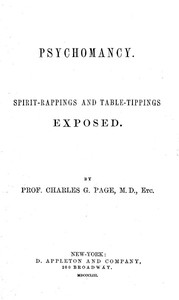
The source record for Psychomancy: Spirit-Rappings and Table-Tippings Exposed — Edition Insights measures this digital text at 21,863 words, 1 hr 36 min estimated reading time, and 2 detected text sections.
The text analysis averages about 29.3 words per sentence, while the detected sections provide another way to judge how the source is divided.
Project Gutenberg metadata also associates the work with “Spiritualism,” connecting these edition facts with the source record’s subject description.
Explore this collection
These alternatives are selected using recorded categories and estimated reading time.
About 87 minutes
Political Philosophy
19,894 recorded words. 9 minutes difference from this book's estimate.
View Gutenberg source #38107About 125 minutes
Political Philosophy
28,740 recorded words. 29 minutes difference from this book's estimate.
View Gutenberg source #45005About 129 minutes
Political Philosophy
29,520 recorded words. 33 minutes difference from this book's estimate.
View Gutenberg source #18493Search stored excerpts and compare books → Choose by your preferences →
Choices use stored catalog measurements. Estimates vary with reading speed. A shared category is a catalog label, not a claim that two books have the same argument or literary quality.
Search reads excerpt text stored with this catalog and links to its associated Gutenberg record. The connection is stored in the site database; this tool does not recheck that every excerpt is word-for-word identical to that external record. Excerpt search does not cover every chapter and does not verify historical publication dates.
Catalog snapshot checked: 2026-09-26. Coverage: 94 public books, 94 available source excerpts.
Calculated from edition completeness, EPUB availability, text structure and catalogue metadata. Not a user rating.
Total of 100 points, scaled to a 2.5-5.0 range. Editions with an empty description or a missing EPUB file are not scored.
Public-domain source text
The source text is kept in the dedicated reader, separate from this catalogue record and its commentary.
Charles G. Page opens his 1853 exposé with a blunt proposition: the "wide-spread and alarming mania" of spirit-rappings and table-tippings is a modern guise for "devilish instrumentalities" operating through human machination. He immediately clarifies that he does not attribute direct supernatural agency to Satan, but insists that no performance can withstand scrutiny under natural laws. This combative, confident tone—challenging believers to "show us the proof to the contrary"—sets the stage for a work that blends theological argument with empirical demonstration.
Page's method is to treat the phenomena as puzzles to be solved by physics and common sense. He describes experiments with iron rods and speaking tubes to show how sound can be mislocalized, and he scrutinizes the Fox sisters' methods, noting their long dresses and reluctance to allow foot examination. The text is a period piece of skeptical science, written in a vigorous, sometimes sarcastic style.
Page frames his argument within a Christian worldview, but he is careful to limit Satan's role. He writes that the "arch-enemy of man" has not introduced any new power; rather, he works through the human soul, his "pliant tool." This theological framework allows Page to dismiss the idea of a new supernatural force while still condemning the practice as morally dangerous. He repeatedly uses the phrase "a new power?" as a rhetorical device, arguing that a genuine new power would be a legitimate subject of scientific pursuit, not something confined to darkened rooms and credulous audiences.
The author's confidence in "Holy Writ" and "the unfailing laws of God" underpins his challenge. He does not merely deny the spirits; he dares proponents to produce evidence that cannot be explained naturally. This dual appeal—to scripture and to empirical science—reflects the intellectual tensions of mid-nineteenth-century America, where revivalism and rationalism often clashed.
Page's most concrete evidence comes from his own experiments. He describes striking an iron rod twenty feet long: a listener at the far end hears the blow "precisely as if the blow was struck near his ear." He extrapolates that a concealed rod passing through a floor could produce mysterious rappings. This demonstration, which he claims to have "tried with entire success," is central to his argument that the ear cannot reliably locate sounds when the source is hidden.
He also cites the "Invisible Lady" illusion from Brewster's Natural Magic and the common speaking tube to show that auditory misdirection is well understood. By linking the Fox sisters' rappings to these known phenomena, Page attempts to demystify them without needing to catch the performers in the act. His tone here is instructional, almost like a lecture, as he walks the reader through the principles of acoustics.
Page devotes considerable attention to the Fox sisters, the most famous spirit-rappers of the era. He notes that there are "no male rappers" of their scale, and he attributes this to the protection afforded by their sex: "Relying upon their sex they trust the courtesy of their visitors as sufficient protection against the examination of even their feet." He observes that they wear "unusually long dresses" to conceal movements and apparatus, and that when one girl stood on tumblers, she did not rap until her dress touched the floor.
These observations are specific and testable. Page does not claim to have caught them in a trick, but he builds a circumstantial case. He also remarks that witches have historically outnumbered wizards, implying a gendered pattern in such deceptions. His language is pointed but not hysterical; he treats the sisters as clever operators rather than supernatural agents.
The provided excerpts break off before Page's conclusion, so we cannot see how he synthesizes his arguments or whether he offers a final verdict on the mania. The text appears to be a sustained polemic, but the later sections might include more detailed case studies or responses to critics. The catalog metadata lists the work under "Ethics" and subjects "Spiritualism" and "Table-moving," suggesting that Page's primary concern is moral and intellectual correction rather than purely scientific exposition.
Readers should be aware that the excerpts represent only the opening and a middle portion. The full book likely contains additional experiments, perhaps with electrical or mechanical tricks, and may address counterarguments from spiritualists. Page's style is energetic and opinionated, and his evidence is a mix of firsthand observation, analogy, and theological reasoning.
Page's Psychomancy rewards readers who enjoy period skeptical writing and the history of science. His combination of moral outrage and hands-on demonstration offers a window into how 19th-century intellectuals grappled with popular spiritualism. To get the most from the text, pay attention to his experimental setups and his rhetorical strategies—he is as much a showman as his opponents, but his stage is the printed page.
Reading how Page turned séance tricks into plain mechanics, I kept thinking of that quieter book sitting on my shelf, the one that traces how a century’s certainties unravel into poetry. Browning and His Century — A Closer Reading lingers differently—less debunking, more a long exhale over what we choose to believe, and what we let go.
Build a private reading journal entry for this title.