About 286 minutes
Hume (English Men of Letters Series) — Context and Discussion
Political Philosophy
65,749 recorded words. 77 minutes difference from this book's estimate.
View Gutenberg source #18819
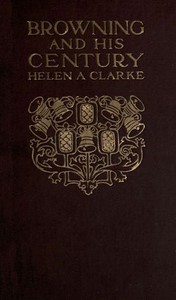
Browning and His Century — A Closer Reading can be approached with a clearer sense of reading commitment from its source measurements: 83,455 words, 6 hr 3 min estimated reading time, and 9 detected text sections.
The text analysis averages about 32.8 words per sentence, while the detected sections provide another way to judge how the source is divided.
Project Gutenberg metadata also associates the work with “Browning, Robert, 1812-1889,” connecting these edition facts with the source record’s subject description.
Explore this collection
These alternatives are selected using recorded categories and estimated reading time.
About 286 minutes
Political Philosophy
65,749 recorded words. 77 minutes difference from this book's estimate.
View Gutenberg source #18819About 510 minutes
Political Philosophy
117,268 recorded words. 147 minutes difference from this book's estimate.
View Gutenberg source #30718About 169 minutes
Political Philosophy
38,790 recorded words. 194 minutes difference from this book's estimate.
View Gutenberg source #43548Search stored excerpts and compare books → Choose by your preferences →
Choices use stored catalog measurements. Estimates vary with reading speed. A shared category is a catalog label, not a claim that two books have the same argument or literary quality.
Search reads excerpt text stored with this catalog and links to its associated Gutenberg record. The connection is stored in the site database; this tool does not recheck that every excerpt is word-for-word identical to that external record. Excerpt search does not cover every chapter and does not verify historical publication dates.
Catalog snapshot checked: 2026-09-26. Coverage: 94 public books, 94 available source excerpts.
Calculated from edition completeness, EPUB availability, text structure and catalogue metadata. Not a user rating.
Total of 100 points, scaled to a 2.5-5.0 range. Editions with an empty description or a missing EPUB file are not scored.
Public-domain source text
The source text is kept in the dedicated reader, separate from this catalogue record and its commentary.
Clarke opens with a prologue poem addressed to Browning, then immediately situates the poet within the nineteenth century's "battle of mind and spirit." She argues that the century's advance guard abandoned inherited traditions, testing every fact and myth "in the laboratory of the intellect." This framing sets up Browning as a figure whose work engages with the era's central conflict between scientific knowledge and spiritual faith.
The book begins with a sonnet titled "Prologue to Robert Browning," which Clarke uses to encapsulate the poet's epistemological stance. The poem's opening lines—"Say not we know but rather that we love, / And so we know enough"—distinguish between mere intellectual knowing and a deeper, soul-based understanding. Clarke glosses this as a rejection of "the mere mind's knowing" in favor of a truth felt through the heart. This prologue serves as a key to the chapters that follow, where Browning's poetry is read as a sustained meditation on the limits of rational knowledge.
Clarke devotes a significant passage to contrasting Browning with Thomas Carlyle. She quotes from Browning's "Bernard de Mandeville," where a Carlyle-like opponent questions why God allows evil to "o'ertop, o'ertower" good. Browning, she argues, refuses to justify evil's existence, instead focusing on the individual's power to work out salvation through struggle. Carlyle, by contrast, "raged and stormed" against social evils but saw no way to turn evil into good. Clarke positions Browning as a "middle-class individualist" and Carlyle as a precursor to socialism—a distinction that structures her analysis of the century's political and social movements.
In the chapter "The Century's End: Promise of Peace," Clarke traces the evolution of liberal thought. She notes that liberalism freed individuals to become property holders but ignored the competitive conditions that prevented true freedom. The working classes then sought freedom through cooperation rather than competition. Clarke cites Carlyle, Ruskin, Matthew Arnold, and especially William Morris as literary figures who contributed to this shift. Morris appears as "the most interesting figure of the century" because he not only talked but acted, embodying the move from intellectual sympathy to active engagement.
The book's nine chapters move from philosophical and religious questions ("The Battle of Mind and Spirit") through political and social analysis ("Political Tendencies," "Social Ideals") to artistic and literary criticism ("Art Shibboleths," "Classic Survivals"). The final chapter, "Prophetic Visions," suggests a forward-looking conclusion. Clarke frequently returns to Browning's poetry as a touchstone, but she also devotes substantial space to other writers—Carlyle, Morris, Swinburne, Rossetti—creating a network of comparisons. The illustrations, including portraits of Browning at ages 23 and 77, reinforce the biographical thread.
Readers interested in Browning's intellectual context will find Clarke's study most useful when read alongside the poems she discusses, particularly "Bernard de Mandeville" and the prologue. Her comparative approach—setting Browning against Carlyle, Morris, and others—illuminates the poet's individualist stance within a broader cultural debate about evil, progress, and social reform.
Browning’s insistence on the soul’s stubborn light—against Carlyle’s weary thunder—feels oddly like a séance’s promise: that something persists beyond the visible argument. I keep returning to that old pamphlet, Psychomancy: Spirit-Rappings and Table-Tippings Exposed — Edition Insights, the way one revisits a childhood doubt. The century’s need to hear the dead speaks in both, I suppose. Just quieter here.
Create a short personal record of your experience with this book.