About 129 minutes
Introduction to Non-Violence — Context and Discussion
Political Philosophy
29,520 recorded words. 40 minutes difference from this book's estimate.
View Gutenberg source #18493
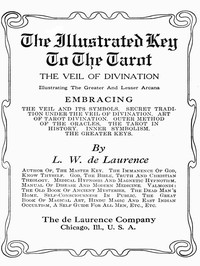
This digital edition of The Illustrated Key to the Tarot: The Veil of Divination — Context and Discussion is described by source-level measurements including 38,790 words, 2 hr 49 min estimated reading time, and 8 detected text sections.
The text analysis averages about 22.5 words per sentence, while the detected sections provide another way to judge how the source is divided.
Project Gutenberg metadata also associates the work with “Fortune-telling by cards,” connecting these edition facts with the source record’s subject description.
Explore this collection
These alternatives are selected using recorded categories and estimated reading time.
About 129 minutes
Political Philosophy
29,520 recorded words. 40 minutes difference from this book's estimate.
View Gutenberg source #18493About 125 minutes
Political Philosophy
28,740 recorded words. 44 minutes difference from this book's estimate.
View Gutenberg source #45005About 96 minutes
Political Philosophy
21,863 recorded words. 73 minutes difference from this book's estimate.
View Gutenberg source #61807Search stored excerpts and compare books → Choose by your preferences →
Choices use stored catalog measurements. Estimates vary with reading speed. A shared category is a catalog label, not a claim that two books have the same argument or literary quality.
Search reads excerpt text stored with this catalog and links to its associated Gutenberg record. The connection is stored in the site database; this tool does not recheck that every excerpt is word-for-word identical to that external record. Excerpt search does not cover every chapter and does not verify historical publication dates.
Catalog snapshot checked: 2026-09-26. Coverage: 94 public books, 94 available source excerpts.
Calculated from edition completeness, EPUB availability, text structure and catalogue metadata. Not a user rating.
Total of 100 points, scaled to a 2.5-5.0 range. Editions with an empty description or a missing EPUB file are not scored.
Public-domain source text
The source text is kept in the dedicated reader, separate from this catalogue record and its commentary.
L. W. de Laurence's The Illustrated Key to the Tarot: The Veil of Divination (1918) presents itself as both a practical guide to cartomancy and a treatise on esoteric symbolism. The catalog assigns it the subject 'Fortune-telling by cards,' yet the preface immediately distances the work from mere divination, calling it a 'doctrine' concerned with 'the highest' mystic schools. This tension between surface utility and hidden meaning runs throughout the text, which is illustrated by Pamela Colman Smith—best known for her Rider-Waite-Smith deck—though the excerpts do not confirm which illustrations appear.
In the preface, de Laurence anticipates criticism for engaging with fortune-telling, framing his work as a continuation of hermetic tradition. He compares himself to the 'most illuminated Frater Christian Rosy Cross,' who, after witnessing the 'Chemical Marriage,' expected to become a door-keeper. This analogy suggests that the highest initiates may take on humble roles—including writing a tarot manual. The author's defensive tone reveals a concern that his subject might be seen as beneath his previous works, which include titles on 'Magical Art' and 'Hindu Magic.' The preface thus establishes that the book is not merely a method of divination but a vehicle for 'higher mystic schools,' though the excerpts do not clarify how this plays out in the instructional sections.
The description of the Fool card exemplifies the book's dual approach. De Laurence portrays the figure as 'a prince of the other world on his travels through this one,' with 'light step' and a 'countenance full of intelligence and expectant dream.' The card is said to reverse 'all the confusions that have preceded it' and to summarize 'many symbols of the Instituted Mysteries.' Yet he also acknowledges the conventional fortune-telling meaning: 'the flesh, the sensitive life,' and notes that its subsidiary name was once 'the alchemist.' This dual reading—esoteric and mundane—reflects the book's overall method: offering symbolic depth while still providing the 'common arts of fortune-telling.' The excerpt does not include the actual divinatory meanings for the Fool, leaving the balance between the two approaches unclear.
De Laurence's treatment of the World card emphasizes its unchangeable design and multiple layers of meaning. He calls it 'the perfection and end of the Cosmos' and 'the rapture of the universe when it understands itself in God (Nature).' He explicitly rejects certain interpretations, such as that it represents 'the absolute' (which he calls 'ridiculous') or that the figure symbolizes the Magus at the highest initiation. Instead, he links it to the 'state of the restored world' and a 'story of the past' when creation was declared good. This careful parsing of meanings—affirming some, dismissing others—shows de Laurence's effort to establish an authoritative reading while distancing himself from earlier occult traditions. The excerpt does not reveal how the card is interpreted in practical divination, leaving the connection to fortune-telling implicit.
Readers approaching this work should be aware that its catalog classification as 'Fortune-telling by cards' captures only one dimension. De Laurence consistently frames the tarot as a symbolic system with roots in mystical tradition, and his commentary on individual cards blends esoteric philosophy with practical method. The excerpts suggest that the book may be most valuable to those interested in early 20th-century occult reinterpretations of the tarot, rather than as a straightforward divination manual.
I keep thinking about that tarot book and how it quietly admitted its own contradictions, the gap between what we call fortune-telling and what we're actually seeking. It reminded me of another piece I stumbled upon once, The Promise of World Peace — Context and Discussion, which lingers in a similar way. Both feel less like answers and more like honest questions left open.
A brief reflection can help important ideas stay with you longer.