About 243 minutes
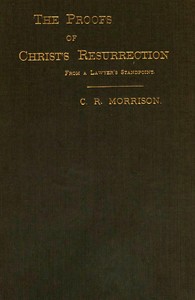
The Proofs of Christ's Resurrection; from a Lawyer's Standpoint — Story, Setting & Ideas
Logic
55,848 recorded words. 27 minutes difference from this book's estimate.
View Gutenberg source #67151
Before opening Demoniality; or, Incubi and Succubi — Story, Setting & Ideas, the edition data offers a quick orientation: 49,488 words, 3 hr 36 min estimated reading time, and 10 detected text sections.
The text analysis averages about 28.6 words per sentence, while the detected sections provide another way to judge how the source is divided.
Project Gutenberg metadata also associates the work with “Catholic Church -- Doctrines,” connecting these edition facts with the source record’s subject description.
Explore this collection
These alternatives are selected using recorded categories and estimated reading time.
About 243 minutes
Logic
55,848 recorded words. 27 minutes difference from this book's estimate.
View Gutenberg source #67151About 162 minutes
Logic
37,071 recorded words. 54 minutes difference from this book's estimate.
View Gutenberg source #52587About 158 minutes
Logic
36,313 recorded words. 58 minutes difference from this book's estimate.
View Gutenberg source #60750Search stored excerpts and compare books → Choose by your preferences →
Choices use stored catalog measurements. Estimates vary with reading speed. A shared category is a catalog label, not a claim that two books have the same argument or literary quality.
Search reads excerpt text stored with this catalog and links to its associated Gutenberg record. The connection is stored in the site database; this tool does not recheck that every excerpt is word-for-word identical to that external record. Excerpt search does not cover every chapter and does not verify historical publication dates.
Catalog snapshot checked: 2026-09-26. Coverage: 94 public books, 94 available source excerpts.
Calculated from edition completeness, EPUB availability, text structure and catalogue metadata. Not a user rating.
Total of 100 points, scaled to a 2.5-5.0 range. Editions with an empty description or a missing EPUB file are not scored.
Public-domain source text
The source text is kept in the dedicated reader, separate from this catalogue record and its commentary.
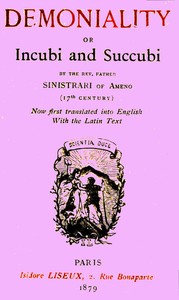
The preface to this 1879 English translation opens not with theology but with a bookshop. Translator Isidore Liseux recounts finding the Latin manuscript in 1872 at Mr. Allen's shop near Regent's Park, a place where folios cost two or three shillings and the proprietor ignored Shakespeare. This bibliographic frame sets a curious stage for the treatise that follows: a 17th-century Franciscan's argument that incubi and succubi are not demons but a separate rational species.
Sinistrari's text, presented with facing Latin and English, moves through scholastic distinctions—whether these beings have bodies, souls, and senses—by weighing Church fathers against everyday reports. The excerpts show a methodical structure: numbered paragraphs, objections from doctors, and appeals to experience, including accounts of incubi mating with horses.
Liseux's preface occupies a significant portion of the opening. He describes Mr. Allen's shop as small, never filled, with books arranged by subject—theology on the right, classics on the left—and priced by size: folios at two or three shillings, octavos at one. The translator portrays himself as a hunter of old books, escaping the present for the company of Aldus and Estienne. This personal narrative, complete with a French aside (Car que faire là bas, à moins qu’on ne bouquine?), establishes the manuscript's provenance as a found object, not an authoritative edition. The contrast between the orderly bookshop and the disorderly subject matter—demonic copulation—creates an ironic tension.
Sinistrari's argument proceeds by numbered paragraphs (e.g., §67) that mimic the quaestio format of medieval theology. He poses objections from the Doctors—that the Evil Spirit simulates passions to entice souls—then counters with evidence from incubi's behavior: they grow sad or angry when denied coition, they mate with beasts, and they do not flee at the name of Jesus or the sign of the cross. The structure is cumulative: each objection is met with a new observation, building toward the conclusion that incubi must have real bodies and rational souls. The Latin text runs parallel, allowing readers to check the original phrasing.
Throughout the excerpts, Sinistrari grounds his argument in physical sensation. He describes the appetitive passion of coition as a sensual passion, visible in animals; incubi incite women and men, and if denied, they sadden and storm, amantes, amentes. The treatise repeatedly invokes daily experience (quotidiana constat experientia) to assert that incubi treat humans and beasts well when gratified, badly when refused. This appeal to observable behavior—rather than scripture alone—marks a distinctive rhetorical move. The image of incubi mating with horses and mares recurs as a test case: if demons seek only to damn souls, why would they bother with animals incapable of eternal damnation?
The facing-page layout forces a constant movement between languages. Sinistrari's Latin is dense with scholastic terminology (appetitiva passio coitus, sensus, anima rationalis), while Liseux's English translation renders it into plainer prose. The preface, originally in French, adds a third linguistic layer. This polyglot structure mirrors the treatise's own border-crossing: between Catholic orthodoxy and heterodox speculation, between learned citation and folk report. Readers may find themselves comparing phrases, noting where the English softens or sharpens the Latin. The effect is that of a palimpsest, with each language commenting on the other.
This edition rewards attention to its margins: the preface, the Latin variants, the footnotes. Sinistrari's method—collecting anecdotes, weighing authorities, testing boundaries—invites readers to consider how theological arguments are built from everyday evidence. The book's structure, moving from bookshop to scholastic debate, mirrors its central question: what kind of being can cross between worlds?
I found myself thinking about that old volume on demoniality recently, the way its careful arguments for unseen beings lingered. It reminded me, oddly, of a legal treatise I once held—The Proofs of Christ's Resurrection; from a Lawyer's Standpoint — Story, Setting & Ideas. Both share that patient, almost stubborn insistence on evidence for what faith simply accepts. Strange company, but both felt earnest in their conviction.
Answer a few questions and save a private reflection on this device.