About 243 minutes
The Proofs of Christ's Resurrection; from a Lawyer's Standpoint — Story, Setting & Ideas
Logic
55,848 recorded words. 81 minutes difference from this book's estimate.
View Gutenberg source #67151
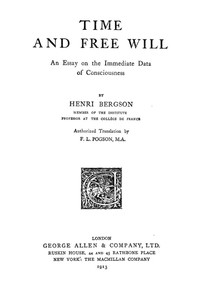
This digital edition of Time and Free Will: An Essay on the Immediate Data of Consciousness — Story, Setting & Ideas is described by source-level measurements including 74,505 words, 5 hr 24 min estimated reading time, and 15 detected text sections.
The text analysis averages about 25.0 words per sentence, while the detected sections provide another way to judge how the source is divided.
Project Gutenberg metadata also associates the work with “Consciousness,” connecting these edition facts with the source record’s subject description.
Explore this collection
These alternatives are selected using recorded categories and estimated reading time.
About 243 minutes
Logic
55,848 recorded words. 81 minutes difference from this book's estimate.
View Gutenberg source #67151About 216 minutes
Logic
49,488 recorded words. 108 minutes difference from this book's estimate.
View Gutenberg source #54243About 162 minutes
Logic
37,071 recorded words. 162 minutes difference from this book's estimate.
View Gutenberg source #52587Search stored excerpts and compare books → Choose by your preferences →
Choices use stored catalog measurements. Estimates vary with reading speed. A shared category is a catalog label, not a claim that two books have the same argument or literary quality.
Search reads excerpt text stored with this catalog and links to its associated Gutenberg record. The connection is stored in the site database; this tool does not recheck that every excerpt is word-for-word identical to that external record. Excerpt search does not cover every chapter and does not verify historical publication dates.
Catalog snapshot checked: 2026-09-26. Coverage: 94 public books, 94 available source excerpts.
Calculated from edition completeness, EPUB availability, text structure and catalogue metadata. Not a user rating.
Total of 100 points, scaled to a 2.5-5.0 range. Editions with an empty description or a missing EPUB file are not scored.
Public-domain source text
The source text is kept in the dedicated reader, separate from this catalogue record and its commentary.
Bergson opens Time and Free Will by distinguishing two forms of multiplicity: the quantitative multiplicity of space, where objects are external to one another, and the qualitative multiplicity of duration, where states permeate and interpenetrate. This distinction is not merely abstract; it shapes his entire method. The translator's preface notes that Bergson's work was completed between 1883 and 1887, and that the author himself collaborated on the English edition, ensuring precision in key terms. Readers should attend to how Bergson uses concrete examples—such as the feeling of a deep melancholy or a violent love—to illustrate his central claim: that analysis, by breaking experience into separate words, replaces the living flux with a lifeless shadow. The opening chapters thus prepare the ground for a critique of psychological associationism and a defense of immediate data.
Bergson argues that we habitually project space into time, treating duration as a homogeneous medium in which moments are juxtaposed like points on a line. This spatialization, he claims, is useful for practical life and language but falsifies the nature of consciousness. In the excerpts, he writes that we “spread out time in space” and thereby cause feelings to “lose their life and their colour.” The result is that we mistake our own shadow for the real feeling. Bergson insists that the immediate data of consciousness are not discrete states but a continuous flux where each moment “permeates” the next. This is not a metaphor but a precise description of how duration is experienced: as a qualitative, organic whole that cannot be divided without distortion.
Bergson makes a striking appeal to the novelist who “tears aside the cleverly woven curtain of our conventional ego.” Such an artist, he says, reveals the “fundamental absurdity” beneath our logical self-presentation. The novelist does not simply reproduce feelings; he arranges their shadow so as to suggest the “extraordinary and illogical nature” of the original. This passage is crucial for understanding Bergson’s method: he does not reject language or analysis outright but uses them to point beyond themselves. The reader should note that Bergson’s own prose often mimics the interpenetration he describes, moving from abstract argument to vivid example and back. The novelist’s role is to bring us “back into our own presence,” a phrase that echoes Bergson’s broader project of recovering immediate experience from intellectual habits.
The excerpts do not fully develop Bergson’s argument for free will, but they establish its foundation. Because duration is a qualitative multiplicity, the self is not a collection of atomic states that can be predicted or measured. Bergson contrasts the “surface” self, which obeys laws of association, with the “deeper” self where states interpenetrate. This deeper self is the locus of freedom: a free act is one that expresses the whole personality, not a choice between pre-existing alternatives. Bergson’s critique of determinism thus hinges on his rejection of spatialized time. Readers should watch for how he later distinguishes between the “dynamic” and “static” aspects of the self, and how he uses examples of decision-making to illustrate the qualitative nature of genuine choice.
Bergson’s argument unfolds through a series of contrasts: space versus duration, analysis versus intuition, the conventional ego versus the real self. His sentences are often long and cumulative, building a sense of movement that mirrors his subject. The translator’s marginal summaries and index, added for the English edition, can help orient the reader, but they should not replace direct engagement with Bergson’s text. Pay attention to his use of italics and repetition: key terms like “duration,” “interpenetration,” and “homogeneous” recur with precise force. Bergson also employs rhetorical questions and hypothetical scenarios to draw the reader into his reasoning. The excerpts show that he is as concerned with method as with conclusions; the book is as much a demonstration of how to philosophize as a set of doctrines.
Bergson’s essay demands a shift in attention: from the measurable to the qualitative, from the abstract to the immediate. Readers will benefit from reading slowly, allowing each example to resonate before moving to the next argument. The translator’s preface and marginal notes provide context, but the core of the work lies in Bergson’s insistence that we can, with effort, recover a sense of duration that is not spatialized. Whether or not one accepts his conclusions, the method he offers—a philosophy that begins with lived experience rather than conceptual frameworks—remains a provocative alternative to intellectualist traditions.
I’ve often thought Bergson’s Time and Free Will shares a quiet kinship with Voltaire: A Sketch of His Life and Works — Story, Setting & Ideas. One measures the lived moment, the other a life spent defying its cages. Both knew that clarity is not a clock’s ticking, but a stubborn, tender refusal to reduce ourselves to numbers. They sit well together on a late shelf.
Answer a few questions and save a private reflection on this device.