About 1,208 minutes
Demonology and Devil-lore — Key Ideas to Explore
Logic
277,828 recorded words. 358 minutes difference from this book's estimate.
View Gutenberg source #40686
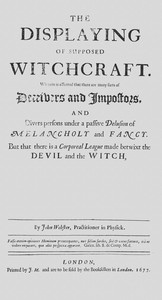
The catalog record for The displaying of supposed witchcraft — Story, Setting & Ideas provides practical reading context through 195,407 words, 14 hr 10 min estimated reading time, and 40 detected text sections.
The text analysis averages about 43.2 words per sentence, while the detected sections provide another way to judge how the source is divided.
Project Gutenberg metadata also associates the work with “Witchcraft,” connecting these edition facts with the source record’s subject description.
Explore this collection
These alternatives are selected using recorded categories and estimated reading time.
About 1,208 minutes
Logic
277,828 recorded words. 358 minutes difference from this book's estimate.
View Gutenberg source #40686About 324 minutes
Logic
74,505 recorded words. 526 minutes difference from this book's estimate.
View Gutenberg source #56852About 243 minutes
Logic
55,848 recorded words. 607 minutes difference from this book's estimate.
View Gutenberg source #67151Search stored excerpts and compare books → Choose by your preferences →
Choices use stored catalog measurements. Estimates vary with reading speed. A shared category is a catalog label, not a claim that two books have the same argument or literary quality.
Search reads excerpt text stored with this catalog and links to its associated Gutenberg record. The connection is stored in the site database; this tool does not recheck that every excerpt is word-for-word identical to that external record. Excerpt search does not cover every chapter and does not verify historical publication dates.
Catalog snapshot checked: 2026-09-26. Coverage: 94 public books, 94 available source excerpts.
Calculated from edition completeness, EPUB availability, text structure and catalogue metadata. Not a user rating.
Total of 100 points, scaled to a 2.5-5.0 range. Editions with an empty description or a missing EPUB file are not scored.
and the benefit of Mankind durst undertake
_Ire per excubias, & se committere Parcis_.
And feared not the tempestuous storms of venemous tongues, or malicious minds, of which we shall here enumerate a competent Catalogue.
[Sidenote: _Præf. in Harvæi Exerc. Anat._]
John Webster opens The Displaying of Supposed Witchcraft with a bold declaration: he will affirm that many are deceivers or under delusion, but utterly deny a corporeal league between devil and witch. The title page alone signals his method—citing Galen on false opinions making men deaf and blind—and his dedication to Yorkshire justices frames the work as self-sufficient, needing no protection. Webster’s voice is combative from the start, dismissing critics as idle and pragmatical persons who scoff at others' labors.
Webster addresses his treatise to five named esquires and justices of the West Riding of Yorkshire, not to beg protection but to assert his work’s independence. He declares that nothing ought to be published that cannot stand like a Noun Substantive without support. This metaphor reveals his rhetorical stance: he presents himself as a self-reliant investigator, wary of malevolent censure. The dedication also hints at his medical background—he signs as Practitioner in Physick—and his audience includes legal authorities, suggesting the book aims to influence both learned opinion and judicial practice regarding witchcraft accusations.
In the later excerpt, Webster engages directly with Joseph Glanvil, a prominent defender of witchcraft beliefs. He disputes Glanvil’s claim that the witch of Endor raised the actual soul of Samuel on a divine errand. Webster counters with seven numbered points: that souls of the dead do not wander, that God would not confirm idolatrous practices by a miracle, and that Samuel, if truly present, would have rebuked both Saul and the witch. He cites the learned Stillingfleet on miracles as criteria of truth, and insists that bare affirmations prove nothing. This passage exemplifies Webster’s method—scriptural reasoning, logical dissection, and appeal to reformed theological consensus.
Webster organizes his case through numbered arguments, a technique that lends an air of systematic proof. He repeatedly challenges opponents to provide proof, reason, or authority, while grounding his own claims in biblical texts and reformed doctrine. His tone is polemical but precise; he accuses Glanvil of laying down affirmation without evidence. The excerpts show a writer who anticipates counterarguments and builds cumulative refutations. Readers should note how Webster moves from general principles (souls do not appear after death) to specific rebuttals (Samuel’s case), always tying his reasoning to the authority of scripture and learned divines.
Though the excerpts focus on theological debate, Webster’s title promises to address astral and sydereal spirits, charms, and philters, as well as the passive delusion of melancholy and fancy. His medical background suggests he will argue that alleged witchcraft phenomena arise from natural causes—disease, imagination, or fraud—rather than demonic agency. The opening denial of corporeal league and transformations into cats or dogs indicates a rationalist stance that challenges popular superstition. Readers should watch for how Webster integrates physiological explanations with his scriptural arguments, creating a dual front against supernatural interpretations.
Webster’s treatise rewards readers who attend to his layered argumentation: he is as much a theologian and physician as a polemicist. The excerpts reveal a writer deeply engaged with contemporary debates, yet his method—numbered points, appeals to authority, and scorn for unsupported claims—remains accessible. Approach the work as a window into 17th-century intellectual conflict, where reason, faith, and medicine intersect in the fight against supposed witchcraft.
There’s a quiet ache in reading Webster’s careful dismantling of every witch trial’s logic, knowing how little it helped the accused. It makes me think of that stranger old book, Demoniality; or, Incubi and Succubi — Story, Setting & Ideas, which circles the same fears from the opposite direction. Both feel like voices calling into a dark room, unanswered. I keep them side by side, just to feel that echo.
Save your reaction, strongest insight, and memorable passage.