About 158 minutes
Death and resurrection from the point of view of the cell-theory — Story, Setting & Ideas
Logic
36,313 recorded words. 4 minutes difference from this book's estimate.
View Gutenberg source #60750
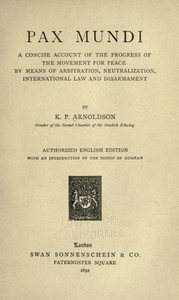
Before opening Pax mundi — Story, Setting & Ideas, the edition data offers a quick orientation: 37,071 words, 2 hr 42 min estimated reading time, and 5 detected text sections.
The text analysis averages about 26.2 words per sentence, while the detected sections provide another way to judge how the source is divided.
Project Gutenberg metadata also associates the work with “Neutrality,” connecting these edition facts with the source record’s subject description.
Explore this collection
These alternatives are selected using recorded categories and estimated reading time.
About 158 minutes
Logic
36,313 recorded words. 4 minutes difference from this book's estimate.
View Gutenberg source #60750About 150 minutes
Logic
34,342 recorded words. 12 minutes difference from this book's estimate.
View Gutenberg source #39124About 141 minutes
Logic
32,403 recorded words. 21 minutes difference from this book's estimate.
View Gutenberg source #64495Search stored excerpts and compare books → Choose by your preferences →
Choices use stored catalog measurements. Estimates vary with reading speed. A shared category is a catalog label, not a claim that two books have the same argument or literary quality.
Search reads excerpt text stored with this catalog and links to its associated Gutenberg record. The connection is stored in the site database; this tool does not recheck that every excerpt is word-for-word identical to that external record. Excerpt search does not cover every chapter and does not verify historical publication dates.
Catalog snapshot checked: 2026-09-26. Coverage: 94 public books, 94 available source excerpts.
Calculated from edition completeness, EPUB availability, text structure and catalogue metadata. Not a user rating.
Total of 100 points, scaled to a 2.5-5.0 range. Editions with an empty description or a missing EPUB file are not scored.
Public-domain source text
The source text is kept in the dedicated reader, separate from this catalogue record and its commentary.
Arnoldson, a Swedish parliamentarian, structures his argument around four concrete mechanisms—arbitration, neutrality, international law, and disarmament—rather than abstract pacifism. The book opens with a prefatory note by J.F.G. and an introduction by the Bishop of Durham, framing the work as a practical statesman's assessment. Arnoldson grounds his analysis in specific treaty obligations and constitutional provisions, such as the Swedo-Norse cabinet councils and the Riksdag's role in treaty confirmation, avoiding generalities.
Arnoldson devotes careful attention to the mechanisms by which a nation may be drawn into war without full legislative consent. He cites three instances where Sweden-Norway narrowly avoided entanglement due to treaties the king could enter without cabinet approval: the Crimean War, the Dano-German War, and the Franco-German War. In each case, external events—the Peace of Paris, the death of King Frederic VII, the battle of Wörth—intervened. Arnoldson proposes amending constitutional formulas so that treaties involving political entanglement require confirmation by the Riksdag and Storting, comparing this to existing requirements for commercial treaties, which he calls "bagatelles" in contrast.
The author tracks parallel reform efforts in the British House of Commons. In 1886, Henry Richard moved to abolish the sovereign's right to declare war without Parliament's consent; the motion was defeated but garnered 109 votes against 115. In 1889, W.R. Cremer proposed a parliamentary committee to examine foreign affairs before they were laid before the House. Though both attempts failed, Arnoldson treats the narrowing margins as "a remarkable sign of the times." He notes Cremer's intention to renew the motion, indicating a persistent, incremental pressure on executive war powers.
Arnoldson draws on an article by Belgian economist de Molinari to illustrate how the internationalization of trade and capital has transformed the stakes of war. In 1613, England's total imports and exports were only five million pounds; two centuries later, the entire European trade was less than modern Belgium's. Foreign loans were negligible, and neutral states suffered little from distant conflicts. By the 1890s, world foreign trade had reached about five thousand million pounds, and capital investments crossed borders extensively. Arnoldson implies that this economic solidarity makes war increasingly costly for neutrals, creating a structural incentive for peace.
Throughout the excerpts, Arnoldson maintains a measured, evidence-driven voice. He does not appeal to emotion or moral outrage but to constitutional specifics and historical precedents. The Bishop of Durham's introduction notes that Arnoldson "indulges in no illusions" and "marks the chief dangers without dissembling their gravity." The author's own prose is direct: he calls assertions about royal power "simply an assertion, refuted by experience." This forensic style, grounded in parliamentary procedure and treaty texts, distinguishes the work from more rhetorical peace literature of the era.
Readers will find that Arnoldson's value lies not in prophecy but in the documentary record he assembles—treaty clauses, parliamentary votes, trade figures—and in his insistence on institutional design. The book is best approached as a primary source for late-19th-century legal and political thought on war prevention, particularly the Scandinavian dimension often overlooked in English-language histories.
That rainy afternoon, Pax mundi left me pondering how nations might dissolve into something quieter. My mind drifted, almost by accident, to cellular mortality, to the strange grace of endings. I found myself reaching for Death and resurrection from the point of view of the cell-theory — Story, Setting & Ideas, and the rain felt softer, more patient.
Your answers remain private and are stored only in this browser.