About 158 minutes
Death and resurrection from the point of view of the cell-theory — Story, Setting & Ideas
Logic
36,313 recorded words. 8 minutes difference from this book's estimate.
View Gutenberg source #60750

For Voltaire: A Sketch of His Life and Works — Story, Setting & Ideas, the stored edition analysis reports 34,342 words, 2 hr 30 min estimated reading time, and 39 detected text sections.
The text analysis averages about 21.3 words per sentence, while the detected sections provide another way to judge how the source is divided.
Project Gutenberg metadata also associates the work with “Voltaire, 1694-1778,” connecting these edition facts with the source record’s subject description.
Explore this collection
These alternatives are selected using recorded categories and estimated reading time.
About 158 minutes
Logic
36,313 recorded words. 8 minutes difference from this book's estimate.
View Gutenberg source #60750About 141 minutes
Logic
32,403 recorded words. 9 minutes difference from this book's estimate.
View Gutenberg source #64495About 162 minutes
Logic
37,071 recorded words. 12 minutes difference from this book's estimate.
View Gutenberg source #52587Search stored excerpts and compare books → Choose by your preferences →
Choices use stored catalog measurements. Estimates vary with reading speed. A shared category is a catalog label, not a claim that two books have the same argument or literary quality.
Search reads excerpt text stored with this catalog and links to its associated Gutenberg record. The connection is stored in the site database; this tool does not recheck that every excerpt is word-for-word identical to that external record. Excerpt search does not cover every chapter and does not verify historical publication dates.
Catalog snapshot checked: 2026-09-26. Coverage: 94 public books, 94 available source excerpts.
Calculated from edition completeness, EPUB availability, text structure and catalogue metadata. Not a user rating.
Total of 100 points, scaled to a 2.5-5.0 range. Editions with an empty description or a missing EPUB file are not scored.
Public-domain source text
The source text is kept in the dedicated reader, separate from this catalogue record and its commentary.
Wheeler and Foote’s Voltaire: A Sketch of His Life and Works (1891) is explicitly offered as “a Freethinker’s tribute” on the bicentenary of Voltaire’s birth. The preface states that the book “has no other pretension than that of being a compilation,” yet it is shaped by a clear point of view: Voltaire is valued as “an apostle of reason and universal toleration.” This editorial note traces how the authors construct their portrait through a collaborative preface, a biographical sketch, and a substantial selection of Voltaire’s writings.
The book’s introduction, signed by Foote alone, reveals an unusual division of labor. Foote writes that Wheeler “had written the greater part” before bringing the work to his attention; Foote’s own role was limited to “going through his copy,” assisting with alterations, reading proofs, and suggesting “further improvements.” He places his name on the title page partly to associate himself with a “dear friend and colleague” and partly to lend his “influence” to the volume’s circulation. This frank admission of secondary contribution is rare in co-authored works and gives the reader a clear sense of Wheeler as the primary researcher and writer. The collaborative dynamic itself becomes a minor theme: the book is as much a joint tribute as a biography.
The excerpts show a biographical style that mixes narrative with pointed anecdote. For instance, the account of Voltaire’s later years includes a story about Gibbon’s alleged attempts to see Voltaire, complete with a reported witticism: “You are like the Christian God: he permits one to eat and drink, but will never show himself.” The authors then undercut the story by noting it is “very unlikely,” yet they include it anyway. This technique—presenting dubious material while signaling its unreliability—appears elsewhere. The narrative also draws heavily on Voltaire’s own words, such as his remark about his church inscription: “I adore God; but not monsieur his son, and madame his mother.” The authors let Voltaire speak for himself, but they also shape the context to emphasize his irreverence.
The preface declares that Voltaire is esteemed “mainly under this aspect” of Freethinker and reformer. This lens governs both the biographical sketch and the selection of writings. The table of contents groups Voltaire’s works under headings like “Doubt and Speculation,” “Superstition,” and “Religious Prejudices,” while omitting any section on his literary or dramatic achievements. The biographical portion highlights conflicts with religious authorities—such as his dispute with Geneva over a private theatre and his continual reminders of Servetus—and presents his theatrical work as “an instrument of education” against intolerance. The authors’ own stance is explicit: they admire Voltaire’s role in “dispersing intolerance and superstition.” The book thus functions as a partisan portrait, not a neutral survey.
Readers should approach this volume as a deliberately partial account, one that foregrounds Voltaire’s battles against religious authority and his advocacy for reason. The selections from his works, which occupy roughly half the book, are chosen to reinforce this interpretation. For a fuller picture, one might consult the sources the authors themselves recommend—Condorcet, Parton, Morley—but as a concentrated statement of late-nineteenth-century Freethought admiration, this sketch remains a revealing document of its own era.
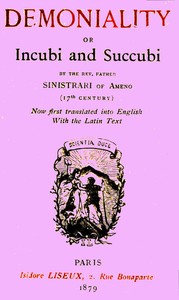
Reading about Wheeler and Foote’s Voltaire, I remembered the old public library’s dim corner where I first found Demoniality; or, Incubi and Succubi — its odd, earnest seriousness felt like a door left ajar. Both books share that quiet daring, the thrill of a mind testing old walls. Demoniality; or, Incubi and Succubi — Story, Setting & Ideas lingers there, a whisper from another century that somehow still touches my shoulder.
Create a short personal record of your experience with this book.