About 29 minutes
Saint Ursula: I. The Story of St. Ursula. II. The Dream of St. Ursula. — Context and Discussion
Ethics
6,601 recorded words. 1 minutes difference from this book's estimate.
View Gutenberg source #30173
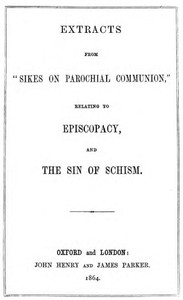
The source record for Extracts from "Sikes on Parochial Communion" relating to Episcopacy, and the sin of Schism — A Closer Reading measures this digital text at 6,375 words, 28 min estimated reading time, and 1 detected text section.
The text analysis averages about 26.6 words per sentence, while the detected sections provide another way to judge how the source is divided.
Project Gutenberg metadata also associates the work with “Episcopacy -- Controversial literature,” connecting these edition facts with the source record’s subject description.
Explore this collection
These alternatives are selected using recorded categories and estimated reading time.
About 29 minutes
Ethics
6,601 recorded words. 1 minutes difference from this book's estimate.
View Gutenberg source #30173About 36 minutes
Ethics
8,121 recorded words. 8 minutes difference from this book's estimate.
View Gutenberg source #40982About 37 minutes
Ethics
8,494 recorded words. 9 minutes difference from this book's estimate.
View Gutenberg source #63746Search stored excerpts and compare books → Choose by your preferences →
Choices use stored catalog measurements. Estimates vary with reading speed. A shared category is a catalog label, not a claim that two books have the same argument or literary quality.
Search reads excerpt text stored with this catalog and links to its associated Gutenberg record. The connection is stored in the site database; this tool does not recheck that every excerpt is word-for-word identical to that external record. Excerpt search does not cover every chapter and does not verify historical publication dates.
Catalog snapshot checked: 2026-09-26. Coverage: 94 public books, 94 available source excerpts.
Calculated from edition completeness, EPUB availability, text structure and catalogue metadata. Not a user rating.
Total of 100 points, scaled to a 2.5-5.0 range. Editions with an empty description or a missing EPUB file are not scored.
Public-domain source text
The source text is kept in the dedicated reader, separate from this catalogue record and its commentary.
The compiler's preface immediately establishes a tone of scarcity and value, noting that Sikes's book is "as scarce as it is valuable" and that these extracts aim to preserve its "sound reasoning and clear expositions." This framing sets up a work that is both defensive and instructional. Sikes's own voice then enters with a declarative sentence: "If the sacred character and divine authority of the Christian priesthood were correctly understood, it would greatly conduce to the prevention of those many divisions which at present distract the Church of Christ." The language is measured, almost legalistic, as he builds a case for episcopal succession.
The opening paragraphs proceed methodically, defining terms and establishing premises. Sikes writes that "every bishop receives his commission, and with it his spiritual authority, immediately from those bishops who consecrated him," tracing a direct line from Christ through the Apostles. The syntax is periodic, with clauses accumulating to build authority. However, as the text moves to discuss schism, the pace quickens. Quotations from Augustine, Vincentius, and Jerome are marshaled in rapid succession: Augustine judges schism "scarcely any crime is so great"; Vincentius calls it "the mother of all heresies"; Jerome notes that "there never yet was any schism that did not invent some false doctrine." The rhythm becomes urgent, almost breathless, as the compiler piles witness upon witness.
Sikes's argument relies heavily on scriptural proof-texts, but he deploys them with varying force. Early on, Christ's words "My kingdom is not of this world" are used to establish the spiritual nature of Church authority. Later, the Great Commission ("Go ye, and make disciples in all nations") is cited to ground the necessity of believing in the Church. The shift from descriptive to imperative is marked: the first half of the extract explains what the Church is; the second half warns what happens to those who reject it. Sikes writes that those "who will not endure sound doctrine will heap to themselves teachers," and the consequence is that "they shall be turned unto fables." The language here is more vivid and condemnatory, a departure from the earlier measured tone.
The preface and footnotes reveal a second layer of authorship. The compiler, who dedicates the work to the Bishop of Oxford, describes Sikes's book as "the product of much thought and deep study" and expresses a desire that it "may not be wholly lost." This framing introduces a note of personal urgency. The compiler also adds a footnote citing 1 Corinthians and Galatians, reinforcing Sikes's points. The effect is a kind of double voice: Sikes's original 18th-century argument is mediated by a 19th-century editor who shares his concerns. The pace of the text is thus punctuated by these editorial interjections, which serve as both homage and amplification.
Readers should attend to the way Sikes builds his case through a chain of authorities—scriptural, patristic, and canonical—and how the compiler's own voice frames the extracts as a rescue operation. The text's rhythm shifts from careful definition to urgent warning, a movement that mirrors its theological argument: order must be established before division can be condemned. The footnotes, though sparse, are worth consulting for the scriptural underpinnings of Sikes's claims.
Sometimes a book stays with you not for its answers but for the weight of its asking. That old tract on episcopal duty felt that way—urgent, layered, quietly unrelenting. I caught echoes of it reading Thoughts on African Colonization — Context and Discussion, where similar conviction presses against history’s margins. Both left me sitting still afterward, not quite sure what to do with the feeling, just holding it.
Answer a few questions and save a private reflection on this device.