About 175 minutes
Thomas Carlyle — Themes and Context
Ethics
40,049 recorded words. 15 minutes difference from this book's estimate.
View Gutenberg source #32626
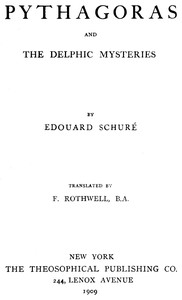
The catalog record for Pythagoras and the Delphic mysteries — Reading Notes provides practical reading context through 43,662 words, 3 hr 10 min estimated reading time, and 13 detected text sections.
The text analysis averages about 21.6 words per sentence, while the detected sections provide another way to judge how the source is divided.
Project Gutenberg metadata also associates the work with “Mysteries, Religious,” connecting these edition facts with the source record’s subject description.
Explore this collection
These alternatives are selected using recorded categories and estimated reading time.
About 175 minutes
Ethics
40,049 recorded words. 15 minutes difference from this book's estimate.
View Gutenberg source #32626About 216 minutes
Ethics
49,538 recorded words. 26 minutes difference from this book's estimate.
View Gutenberg source #58222About 163 minutes
Ethics
37,478 recorded words. 27 minutes difference from this book's estimate.
View Gutenberg source #74156Search stored excerpts and compare books → Choose by your preferences →
Choices use stored catalog measurements. Estimates vary with reading speed. A shared category is a catalog label, not a claim that two books have the same argument or literary quality.
Search reads excerpt text stored with this catalog and links to its associated Gutenberg record. The connection is stored in the site database; this tool does not recheck that every excerpt is word-for-word identical to that external record. Excerpt search does not cover every chapter and does not verify historical publication dates.
Catalog snapshot checked: 2026-09-26. Coverage: 94 public books, 94 available source excerpts.
Calculated from edition completeness, EPUB availability, text structure and catalogue metadata. Not a user rating.
Total of 100 points, scaled to a 2.5-5.0 range. Editions with an empty description or a missing EPUB file are not scored.
Public-domain source text
The source text is kept in the dedicated reader, separate from this catalogue record and its commentary.
Edouard Schuré’s Pythagoras and the Delphic Mysteries, translated by Fred Rothwell in 1909, opens not with biography but with a sweeping claim: “The soul of Orpheus had passed like a divine meteor across the troubled heavens of a new-born Greece.” This sentence establishes a voice that is at once oracular and declarative, blending cosmic imagery with historical assertion. Throughout the excerpts, Schuré consistently favors metaphorical condensation over plain exposition—seas are “produced by the tears of Saturn,” and the earth’s cooling is rendered as a mythic process. The translator preserves this register, which oscillates between the scholarly and the hieratic. The work’s structure, as indicated by its table of contents, moves from a panoramic sixth-century Greece through travel, the Delphic temple, and a four-degree initiation system, culminating in Pythagoras’s marriage and death. This arrangement suggests a deliberate arc from historical context to esoteric instruction, with the temple as the doctrinal pivot.
Schuré’s lexical choices consistently elevate the subject matter into a realm of sacred mystery. Words like “meteor,” “wrapt,” “interdict,” and “initiator” recur, creating a tone that is both archaic and authoritative. The opening paragraph alone uses “divine meteor,” “troubled heavens,” and “darkness” to frame Orpheus’s legacy as a fleeting illumination. This is not neutral history; it is a narrative of persecution and hidden knowledge. The translator, Fred Rothwell, retains Latinate constructions (“unbridled licence,” “pure doctrine”) that reinforce the gravity. Notably, Schuré avoids modern scientific terminology even when discussing evolution: “the percussion of the earth by celestial powers” replaces a mechanistic explanation with an energetic, almost poetic one. This diction signals to the reader that the text operates within a theosophical framework, where spiritual forces are the primary agents of change.
Dialogue in the excerpts is sparse but pointed. When Pythagoras speaks to his disciples, his words are summarized as “metaphorically” summing up ideas: “the seas were produced by the tears of Saturn (cosmic time).” This is not conversational exchange but didactic pronouncement. The text rarely presents direct quotation; instead, it filters Pythagoras’s teachings through indirect discourse, maintaining the master’s authority while keeping the reader at a remove. The effect is that of a transmitted secret—the reader overhears instruction meant for initiates. In the chapter on the temple, the Pythoness Theoclea is mentioned but not given voice; her role is described rather than dramatized. This choice prioritizes doctrine over character, aligning with the work’s apparent purpose as an exposition of esoteric principles rather than a biographical narrative.
Schuré’s descriptive passages frequently shift from the particular to the cosmic. The earth’s formation is described through “successive coolings,” but immediately framed as “the tears of Saturn.” Continents emerge and disappear through “oscillation of the poles,” and humanity passes through “six deluges.” The scale is vast, and the language is correspondingly grand: “the mighty and poignant, the eternal mystery” is posed as the central problem. Descriptions of matter—earth, water, air, fire, ether—are enumerated with a pseudo-scientific precision that quickly gives way to metaphysical claims: the fifth element is “no longer atomic” and possesses “universal penetration.” This blending of ancient cosmology with nineteenth-century esoteric terminology (e.g., “astral light”) creates a distinctive descriptive texture. The reader is asked to visualize not just a historical setting but a layered universe of correspondences.
The book’s structure mirrors the initiation it describes. The table of contents reveals a progression: after contextual chapters, the temple section introduces the “Science of Apollo” and “Theory of Divination,” followed by a four-degree initiation (Test, Preparation, Purification, Perfection, Epiphany). This is not a linear biography but a pedagogical ascent. The excerpts from later chapters show Pythagoras teaching about elemental states and cosmic cycles, suggesting that the doctrine is revealed gradually. The final chapter, covering marriage, revolution, and the master’s end, implies a return to historical narrative after the doctrinal core. This architecture—context, travel, temple, degrees, denouement—positions the reader as a potential initiate, moving from outer history to inner teaching and back. The work thus enacts its subject matter structurally, a deliberate authorial choice that reinforces the esoteric theme.
Readers approaching this text should attend to the interplay between its historical claims and its mythopoeic language. Schuré does not argue for Pythagoras’s influence through evidence alone; he constructs a voice that demands belief in the reality of hidden wisdom. The translator’s fidelity to this voice means that the English text retains a late-Victorian, theosophical cadence. For those interested in how esoteric traditions were packaged for early twentieth-century audiences, the work offers a rich case study in rhetorical strategy. It is less a biography than a doctrinal romance, and its value lies in the consistency of its imaginative vision.
That Schuré book left me thinking about how belief shapes the stories we tell ourselves, the way he weaves doctrine into drama so gently. It reminded me of something quieter, a lecture about whether life holds meaning without eternity—a question that lingered with me like an old hymn. We might talk about it sometime: Is Life Worth Living Without Immortality? A Lecture Delivered Before the Independent Religious Society, Chicago — Context and Discussion.
Your answers remain private and are stored only in this browser.