About 72 minutes
The Inevitable Crimes of Celibacy The Vices of Convents and Monasteries, Priests and Nuns — Background and Themes
Ethics
16,445 recorded words. 2 minutes difference from this book's estimate.
View Gutenberg source #56041
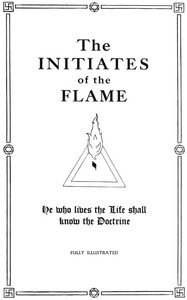
The source record for The Initiates of the Flame — A Closer Reading measures this digital text at 16,798 words, 1 hr 14 min estimated reading time, and 3 detected text sections.
The text analysis averages about 26.6 words per sentence, while the detected sections provide another way to judge how the source is divided.
Project Gutenberg metadata also associates the work with “Occultism,” connecting these edition facts with the source record’s subject description.
Explore this collection
These alternatives are selected using recorded categories and estimated reading time.
About 72 minutes
Ethics
16,445 recorded words. 2 minutes difference from this book's estimate.
View Gutenberg source #56041About 71 minutes
Ethics
16,177 recorded words. 3 minutes difference from this book's estimate.
View Gutenberg source #35417About 77 minutes
Ethics
17,542 recorded words. 3 minutes difference from this book's estimate.
View Gutenberg source #45158Search stored excerpts and compare books → Choose by your preferences →
Choices use stored catalog measurements. Estimates vary with reading speed. A shared category is a catalog label, not a claim that two books have the same argument or literary quality.
Search reads excerpt text stored with this catalog and links to its associated Gutenberg record. The connection is stored in the site database; this tool does not recheck that every excerpt is word-for-word identical to that external record. Excerpt search does not cover every chapter and does not verify historical publication dates.
Catalog snapshot checked: 2026-09-26. Coverage: 94 public books, 94 available source excerpts.
Calculated from edition completeness, EPUB availability, text structure and catalogue metadata. Not a user rating.
Total of 100 points, scaled to a 2.5-5.0 range. Editions with an empty description or a missing EPUB file are not scored.
Public-domain source text
The source text is kept in the dedicated reader, separate from this catalogue record and its commentary.
Manly P. Hall's The Initiates of the Flame opens with a striking claim: that even in modern civilization, there are souls who guard the sacred fires of ancient temples. The prose immediately establishes a tone of esoteric authority, blending historical sweep with moral urgency. Hall writes of nations that have fallen—Greece, Rome, Egypt—and warns that contemporary societies may follow, their light extinguished. Yet the central image is not decline but continuity: a great hand from the unseen regulates human affairs, and the eternal Flame nourishes all creation. This introduction sets up the book's core argument—that spiritual initiation is not confined to antiquity but manifests in everyday life, visible to those who recognize the insignia of inner rank.
The structure of the introduction mirrors this authority. Hall moves from the fall of ancient nations to the present, then to a cosmic principle—the eternal Flame—and back to the individual. This circular logic reinforces the idea that all history and personal experience are governed by the same spiritual law. The reader is positioned as one who may, if attentive, perceive the hidden order.
The language here is concrete despite the abstract subject. Hall speaks of the dusky towers and factory chimneys fading into the templed pillars of Luxor, and of a man with a lunch pail being as much a king as when he wore the crown of the double Nile. This juxtaposition of the mundane and the sacred is a deliberate stylistic choice, grounding esoteric ideas in recognizable imagery.
The excerpt breaks off before Hall develops the Ark's significance fully, but the pattern is clear: he uses a well-known symbol to demonstrate that all religions share a hidden core. The reader is left to infer that the Ark, like the Flame, is a metaphor for an inner reality accessible through initiation.
Hall extends this idea to everyday life: the modern initiate may be a laborer, his face brown with honest dirt, yet he is as much a king as any pharaoh. This democratization of spiritual aristocracy is a striking feature of the book. It suggests that the true priesthood is not an institution but a state of being, accessible to anyone who recognizes the Flame within. The author's tone here is both exhortatory and reassuring, urging the reader to see the sacred in the ordinary.
Hall's prose rewards readers who attend to his symbolic language and rhetorical patterns. The book is not a systematic treatise but a series of meditations on a central theme: the persistence of spiritual initiation across time and culture. Readers should approach it as an invitation to see the world through a different lens, one where factory chimneys become temple pillars and a lunch pail is a king's scepter. The evidence for these claims is not historical but experiential—Hall asks his audience to test his ideas against their own perceptions of human character and hidden nobility.
I’ve often thought that the quiet fire in The Initiates of the Flame burns differently for those who know the soul-work of Anna Kingsford and Edward Maitland. Their shared inner seeking, that patient trust in vision, feels like a whispered echo. Here, in The Story of Anna Kingsford and Edward Maitland and of the new Gospel of Interpretation — Text and Context, the same ember glows, unhurried, awaiting any wanderer’s glance.
Save your reaction, strongest insight, and memorable passage.