About 71 minutes
The Super Race: An American Problem — Background and Themes
Ethics
16,177 recorded words. 1 minutes difference from this book's estimate.
View Gutenberg source #35417
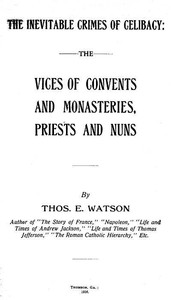
The catalog record for The Inevitable Crimes of Celibacy The Vices of Convents and Monasteries, Priests and Nuns — Background and Themes provides practical reading context through 16,445 words, 1 hr 12 min estimated reading time, and 2 detected text sections.
The text analysis averages about 21.8 words per sentence, while the detected sections provide another way to judge how the source is divided.
Project Gutenberg metadata also associates the work with “Catholic Church -- Controversial literature,” connecting these edition facts with the source record’s subject description.
Explore this collection
These alternatives are selected using recorded categories and estimated reading time.
About 71 minutes
Ethics
16,177 recorded words. 1 minutes difference from this book's estimate.
View Gutenberg source #35417About 74 minutes
Ethics
16,798 recorded words. 2 minutes difference from this book's estimate.
View Gutenberg source #55687About 77 minutes
Ethics
17,542 recorded words. 5 minutes difference from this book's estimate.
View Gutenberg source #45158Search stored excerpts and compare books → Choose by your preferences →
Choices use stored catalog measurements. Estimates vary with reading speed. A shared category is a catalog label, not a claim that two books have the same argument or literary quality.
Search reads excerpt text stored with this catalog and links to its associated Gutenberg record. The connection is stored in the site database; this tool does not recheck that every excerpt is word-for-word identical to that external record. Excerpt search does not cover every chapter and does not verify historical publication dates.
Catalog snapshot checked: 2026-09-26. Coverage: 94 public books, 94 available source excerpts.
Calculated from edition completeness, EPUB availability, text structure and catalogue metadata. Not a user rating.
Total of 100 points, scaled to a 2.5-5.0 range. Editions with an empty description or a missing EPUB file are not scored.
Public-domain source text
The source text is kept in the dedicated reader, separate from this catalogue record and its commentary.
Watson opens not with clerical celibacy but with a broad analogy: robbery disguised as law is more destructive than open theft. He moves from tariff laws to tithes, then to the French Revolution, before finally arriving at his subject. This layered preamble establishes a rhetorical pattern—each paragraph escalates the scale of harm, from nomad bands to parliaments, from free-will offerings to legalized exactions. The prose is declarative, stacking examples in long, periodic sentences that accumulate force. Watson’s voice is that of a prosecutor assembling evidence, not a theologian debating doctrine.
The first chapter does not begin with celibacy. Instead, Watson builds a chain of comparisons: highwaymen versus law-made robbers, voluntary religious gifts versus tithes enforced by statute. Each analogy widens the scale of damage. The nomad robber leaves plains unchanged; the legal robber turns regions into deserts. This structure implies that celibacy, once codified, produces crimes far worse than individual vice. Watson’s syntax mirrors this escalation—short declarative sentences give way to longer, clause-heavy lists (Rockefellers, Carnegies, Morgans). The reader is led stepwise from economic predation to sexual, though the latter is not yet named. The analogies do the work of argument before any evidence is cited.
Watson marshals a series of witnesses: Honorius of Antrim, King Edgar, Pope Benedict VIII, Nicholas Clemangis, Anselm of Bisate, Cyprian. Each is quoted or paraphrased to testify that convents and monasteries were places of debauchery. The quotations are short, often shocking—"places of abomination and debauchery," "the nuns are not more virtuous than the monks." Watson does not analyze these sources; he stacks them. The effect is cumulative, a chorus of condemnation from within the church itself. He also references modern authorities (Dr. Sanger, Krafft-Ebing) to anchor the historical claims in contemporary sexology. The pace quickens as quotation follows quotation, building a sense of overwhelming evidence.
Midway through the excerpt, Watson shifts from historical citation to personal grievance. He writes that if he quoted Cyprian’s Latin, the U.S. Government "would perhaps again prosecute me for telling the truth on Roman Catholicism." This is a sudden change in register—from scholarly compilation to first-person defiance. The sentence is parenthetical, almost an aside, but it reveals the polemical frame: Watson presents himself as a truth-teller under threat. The phrase "again prosecute" hints at prior legal trouble, though the excerpt does not specify. This moment of self-reference breaks the historical narrative and reminds the reader that the author is not a neutral compiler but an engaged combatant. The tone becomes more urgent, less measured.
Watson’s prose moves between two speeds: a deliberate, analogical opening and a rapid-fire sequence of quotations. Readers may find the early pages slow, as the argument circles toward its target. Once the historical witnesses appear, the pace accelerates. The book does not argue so much as accumulate. Pay attention to the transitions—when Watson shifts from economic to sexual examples, and when he inserts himself into the text. These moments reveal the rhetorical strategy beneath the surface of evidence.
There’s something strangely companionable about old arguments, and Watson’s anger at celibacy feels less like a lecture than a weary sigh. I found myself thinking of it while turning through the quieter, more contemplative pages of The Yoga-Vasishtha Maharamayana of Valmiki, Vol. 2 (of 4), Part 1 (of 2) — Text and Context. Both wrestle with renunciation, but one sees it as a trap, the other as a door. I only wish they could have sat together.
Build a private reading journal entry for this title.