About 561 minutes
Modern Skepticism A Course of Lectures Delivered at the Request of the Christian Evidence Society — Text and Context
Ethics
128,908 recorded words. 4 minutes difference from this book's estimate.
View Gutenberg source #42957
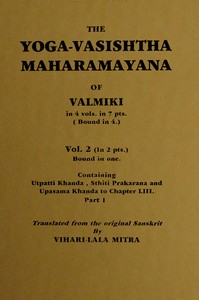
The catalog record for The Yoga-Vasishtha Maharamayana of Valmiki, Vol. 2 (of 4), Part 1 (of 2) — Text and Context provides practical reading context through 129,832 words, 9 hr 25 min estimated reading time, and 77 detected text sections.
The text analysis averages about 23.8 words per sentence, while the detected sections provide another way to judge how the source is divided.
Project Gutenberg metadata also associates the work with “Religious life -- Hinduism -- Early works to 1800,” connecting these edition facts with the source record’s subject description.
Explore this collection
These alternatives are selected using recorded categories and estimated reading time.
About 561 minutes
Ethics
128,908 recorded words. 4 minutes difference from this book's estimate.
View Gutenberg source #42957About 592 minutes
Ethics
136,100 recorded words. 27 minutes difference from this book's estimate.
View Gutenberg source #61724About 604 minutes
Ethics
138,903 recorded words. 39 minutes difference from this book's estimate.
View Gutenberg source #35110Search stored excerpts and compare books → Choose by your preferences →
Choices use stored catalog measurements. Estimates vary with reading speed. A shared category is a catalog label, not a claim that two books have the same argument or literary quality.
Search reads excerpt text stored with this catalog and links to its associated Gutenberg record. The connection is stored in the site database; this tool does not recheck that every excerpt is word-for-word identical to that external record. Excerpt search does not cover every chapter and does not verify historical publication dates.
Catalog snapshot checked: 2026-09-26. Coverage: 94 public books, 94 available source excerpts.
Calculated from edition completeness, EPUB availability, text structure and catalogue metadata. Not a user rating.
Total of 100 points, scaled to a 2.5-5.0 range. Editions with an empty description or a missing EPUB file are not scored.
Public-domain source text
The source text is kept in the dedicated reader, separate from this catalogue record and its commentary.
The second volume of Vihari-Lala Mitra's translation of the Yoga-Vasishtha Maharamayana opens with the Utpatti Khanda (Book III) and continues into the Sthiti Prakarana, reaching the Upasama Khanda through Chapter LIII. The text presents a sustained philosophical dialogue framed by narrative episodes, such as the meditation of the sons of Indu, who sit in padmasana and envision themselves as Brahma, containing the entire universe within their minds. This passage exemplifies the work's central method: using vivid, cosmological imagery to illustrate the identity of the individual self with the absolute. The translator's notes, including references to the commentary by Ananda Bodhendra Saraswati, indicate a layered textual tradition.
The excerpt describing the sons of Indu's meditation (Chapter LXXXVII) offers a striking example of the text's imaginative reach. The brothers, seated motionless 'like fixed rocks,' mentally project themselves as Brahma, the creator and sustainer. They declare, 'I see in me the spheres of the regents, of the world, and the circles of the Siddhas revolving about me.' The passage enumerates a vast hierarchy: the Vedas, the gods, the terraqueous orb with its oceans and continents, the infernal world with its demons, and the twelve suns. This is not merely a list but a structured vision of totality, where the meditator claims to observe 'the revolution of years and ages' and even a Kalpa passing away. The translator's gloss emphasizes that this 'subjective view of the objective' constitutes the essence of yoga meditation.
Mitra's translation, first published in 1899, bears the marks of its era and its source material. The transcriber's notes for this Project Gutenberg edition record silent corrections of obvious misspellings and several emendations, such as 'the did' to 'did the' and 'can comesout' to 'can come out.' More significantly, the editors consulted two other reprints (Bharatiya Publishing House 1978 and Parimal Publications 1998) to supply missing or unclear text from the scanned LPP edition. The presence of angle brackets to indicate inserted words, and the acknowledgment that some Devanagari in footnotes is a 'best guess,' remind the reader that this digital version is a reconstruction. The translation itself uses a distinctive system of accents (á, í, ú) to mark long vowels, and the term 'Gloss.' refers to the classical Sanskrit commentary by Ananda Bodhendra Saraswati.
Across the excerpts, a consistent pattern emerges: the meditative posture (padmasana) and physical stillness are prerequisites for an expansive inner vision. The brothers sit 'in their motionless postures like fixed rocks, and as images hewn out of stones.' This immobility contrasts with the dynamic, all-encompassing content of their meditation. They see 'some rising and falling, and others diving and floating, like the incessant waves of the sea'—a simile that underscores change within the changeless observer. The text repeatedly links the microcosm of the human mind to the macrocosm of the universe: the meditator contains 'the hollow of the infernal world' and 'the cavity of the sky.' This structural parallel between inner and outer reality is a key philosophical tenet, presented not as abstract doctrine but through concrete, sensory imagery.
Readers approaching this volume should be prepared for a text that moves between narrative, philosophical exposition, and visionary poetry. The translation's late-nineteenth-century style and the reconstructed nature of the digital edition warrant attention to the textual notes. The work rewards those who engage with its repetitive, incantatory quality, where the same cosmic themes are refracted through different episodes and similes. The meditation of the sons of Indu serves as a useful touchstone for understanding the text's method: stillness giving rise to a universe.
The rain blurred the window as I sat with the brothers’ padmasana visions, watching worlds dissolve into subjective light. The stillness felt almost ecclesiastical, a quiet pressing against certainty. Later, thumbing through Writings in Connection with the Donatist Controversy — Edition Insights, I found that same patient wrestling over what is real in a divided church. Two books, one afternoon, both asking how deeply we can trust what we believe.
Build a private reading journal entry for this title.