About 1,001 minutes
The Yoga-Vasishtha Maharamayana of Valmiki, Vol. 3 (of 4), Part 2 (of 2) — Context and Discussion
Ethics
230,055 recorded words. 57 minutes difference from this book's estimate.
View Gutenberg source #46531
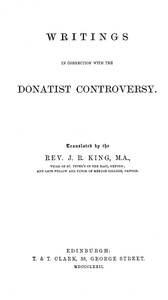
For Writings in Connection with the Donatist Controversy — Edition Insights, the stored edition analysis reports 216,991 words, 15 hr 44 min estimated reading time, and 32 detected text sections.
The text analysis averages about 29.4 words per sentence, while the detected sections provide another way to judge how the source is divided.
Project Gutenberg metadata also associates the work with “Donatists -- Controversial literature,” connecting these edition facts with the source record’s subject description.
Explore this collection
These alternatives are selected using recorded categories and estimated reading time.
About 1,001 minutes
Ethics
230,055 recorded words. 57 minutes difference from this book's estimate.
View Gutenberg source #46531About 876 minutes
Ethics
201,459 recorded words. 68 minutes difference from this book's estimate.
View Gutenberg source #45422About 1,016 minutes
Ethics
233,578 recorded words. 72 minutes difference from this book's estimate.
View Gutenberg source #45304Search stored excerpts and compare books → Choose by your preferences →
Choices use stored catalog measurements. Estimates vary with reading speed. A shared category is a catalog label, not a claim that two books have the same argument or literary quality.
Search reads excerpt text stored with this catalog and links to its associated Gutenberg record. The connection is stored in the site database; this tool does not recheck that every excerpt is word-for-word identical to that external record. Excerpt search does not cover every chapter and does not verify historical publication dates.
Catalog snapshot checked: 2026-09-26. Coverage: 94 public books, 94 available source excerpts.
Calculated from edition completeness, EPUB availability, text structure and catalogue metadata. Not a user rating.
Total of 100 points, scaled to a 2.5-5.0 range. Editions with an empty description or a missing EPUB file are not scored.
Public-domain source text
The source text is kept in the dedicated reader, separate from this catalogue record and its commentary.
Augustine's Writings in Connection with the Donatist Controversy opens with a sustained, point-by-point refutation of Petilianus, a Donatist bishop. The translation by J.R. King preserves the forensic structure of the original: each of Petilianus's claims is quoted, then answered with a numbered response. This dialogic format—charge and counter-charge—reveals the rhetorical engine of the controversy. Augustine does not merely assert; he dissects his opponent's analogies, such as the comparison of false baptism to a painted portrait or a mirror's reflection, and turns them back against the Donatist position.
Augustine repeatedly insists that the efficacy of baptism does not depend on the moral character of the minister. In response to Petilianus's claim that a guilty priest cannot confer true baptism, Augustine retorts: 'if a guilty man baptizes with a false baptism, then none of those have true baptism who are baptized by men in your party, that are, I do not say openly, but even secretly guilty.' This argument exposes a logical trap for the Donatists: if they admit that a minister's hidden sin invalidates his sacraments, then their own clergy, whose sins may be unknown, would also lack valid baptism. Augustine anchors his position in the objective nature of the sacrament, which has 'Christ for its authority, not any man.'
Petilianus employs vivid analogies to argue that false baptism imitates true baptism deceptively: 'a picture imitates the true man of nature' and 'the brilliancy of a mirror catches the countenance.' Augustine counters by distinguishing between the falseness of the minister and the truth of the sacrament. He asks why, if Donatist clergy deposed for seduction were 'false,' they could still 'both have and give true baptism.' The answer lies in the distinction between human deceit and divine truth: 'the Holy Spirit fled from them was the falseness of man, not the truth of the sacrament.' This line of reasoning reinforces the Catholic position that the sacrament's validity is independent of the minister's worthiness.
Augustine invokes the parable of the wheat and tares to defend the Catholic Church's inclusivity against Donatist separatism. He asserts that the 'wheat of the Lord' grows 'among the tares throughout the whole field, that is, throughout the whole of this world, until the harvest.' The Donatists, by seeking a pure church of only the righteous, misunderstand the nature of the visible church, which must tolerate sinners until the final judgment. Augustine warns against premature separation, arguing that even among 'the very tares' and 'the very chaff,' true baptism can exist. This eschatological perspective frames the controversy not merely as a dispute over ritual, but as a question of how the church should embody holiness in a fallen world.
Readers approaching this volume should attend to the interplay of scripture, logic, and rhetorical strategy. Augustine's method is not systematic theology but polemical engagement: he quotes his opponent, then dismantles each point with a combination of biblical citation and dialectical reasoning. The translation by J.R. King, while Victorian in style, preserves the sharpness of these exchanges. For those unfamiliar with the Donatist schism, the editor's preface and the table of contents provide essential context, but the text itself rewards close reading of its argumentative structure.
There’s something grounding about Augustine’s insistence that grace isn’t contingent on human worthiness—a quiet relief, really. It lingered with me long after. That same gentle thread runs through Doctrine of the Will — A Reader’s Guide, though it approaches the question more introspectively. I found myself thinking about how much of our inner life rests on that very mercy.
Answer a few questions and save a private reflection on this device.