About 805 minutes
Life and Correspondence of David Hume, Volume 2 — Edition Insights
Ethics
185,013 recorded words. 16 minutes difference from this book's estimate.
View Gutenberg source #42844
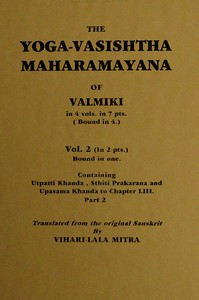
The Yoga-Vasishtha Maharamayana of Valmiki, Vol. 2 (of 4), Part 2 (of 2) — Inside the Classic can be approached with a clearer sense of reading commitment from its source measurements: 181,297 words, 13 hr 9 min estimated reading time, and 120 detected text sections.
The text analysis averages about 25.3 words per sentence, while the detected sections provide another way to judge how the source is divided.
Project Gutenberg metadata also associates the work with “Religious life -- Hinduism -- Early works to 1800,” connecting these edition facts with the source record’s subject description.
Explore this collection
These alternatives are selected using recorded categories and estimated reading time.
About 805 minutes
Ethics
185,013 recorded words. 16 minutes difference from this book's estimate.
View Gutenberg source #42844About 755 minutes
Ethics
173,590 recorded words. 34 minutes difference from this book's estimate.
View Gutenberg source #60212About 832 minutes
Ethics
191,356 recorded words. 43 minutes difference from this book's estimate.
View Gutenberg source #71249Search stored excerpts and compare books → Choose by your preferences →
Choices use stored catalog measurements. Estimates vary with reading speed. A shared category is a catalog label, not a claim that two books have the same argument or literary quality.
Search reads excerpt text stored with this catalog and links to its associated Gutenberg record. The connection is stored in the site database; this tool does not recheck that every excerpt is word-for-word identical to that external record. Excerpt search does not cover every chapter and does not verify historical publication dates.
Catalog snapshot checked: 2026-09-26. Coverage: 94 public books, 94 available source excerpts.
Calculated from edition completeness, EPUB availability, text structure and catalogue metadata. Not a user rating.
Total of 100 points, scaled to a 2.5-5.0 range. Editions with an empty description or a missing EPUB file are not scored.
Public-domain source text
The source text is kept in the dedicated reader, separate from this catalogue record and its commentary.
The Yoga-Vasishtha Maharamayana opens this volume with a scene of departure and return: sages, princes, and citizens disperse after an assembly, each group moving to its proper sphere—foresters to forests, aerials to the air. The translator, Viharilala Mitra, renders this cosmic order in measured verse, where even the act of leaving is a ritual. King Dasaratha honors the sages one by one; Vasishtha, after being adored by Ráma and the princes, proceeds to his hermitage “as the god Brahmá is accompanied by bodies of the celestials.” This hierarchical, ceremonial tone establishes that the text operates within a world where divine and human actions mirror each other, and where every gesture carries weight.
The second chapter, “Ráma’s Recapitulation of Vasishtha’s Lectures,” shows how the text embeds philosophical instruction within daily observance. After the assembly, each character performs prescribed rites: bathing in sacred streams, donating land and kine, worshipping Vishnu and Siva, making oblations to the sun and planets. The description is precise—offerings of “gold and gems” are “sacred to particular deities”—and the rhythm of the day is marked by watches (yamárdha) and the fading of daylight. This ritual scaffolding is not decorative; it provides the context for Ráma’s wakeful night. While others sleep, he lies on his “downy and flowery bed” meditating on the sage’s words. The contrast between communal observance and solitary reflection hints at how the text uses routine to frame moments of deeper inquiry.
In the same chapter, the narrative shifts from external action to internal focus. After the evening hymn and the rising of the moon, “the eyes of all men were folded in sleep,” but Ráma “kept waking in his bed, meditating on all things he had heard.” This moment is the pivot: the text moves from describing what characters do to what one character thinks. The excerpts do not reveal the content of Ráma’s meditation, but the structure suggests that the lectures themselves—the core of the Yoga-Vasishtha—will be delivered through his recollection. For a first reader, this signals that the work’s philosophical arguments are not abstract but arise from a specific dramatic situation: a prince’s restless night. The setting—a bed sprinkled with camphor powder, appearing “as a sheet of spreading moon-light”—adds a sensory layer that grounds the introspection.
Mitra’s translation, first published in 1899, is presented here with extensive transcriber’s notes that document corrections and ambiguities. The Project Gutenberg edition records missing lines, swapped pages, and illegible Devanagari characters, drawing on two other reprints (Bharatiya and Parimal) to fill gaps. For example, page 687 was supplied from the Bharatiya edition because the original contained a duplicate of page 887. These notes alert the reader that the text is a reconstructed artifact, not a pristine original. The translator also normalizes Sanskrit spellings and uses á, í, ú for long vowels—a typographical choice that may affect pronunciation for readers unfamiliar with transliteration conventions. A first reader should be aware that the volume’s 181,297 words span 120 text sections, and that the editorial apparatus is part of the experience.
The excerpts balance vast cosmological references with minute particulars. Vasishtha is compared to Brahmá, but the narrative also notes the “floating bushes of lotuses” and “ruddy geese, cranes and storks” at the riverbank. The text moves between the aerial and the earthly, the subterraneous and the domestic. This juxtaposition is not merely descriptive; it reflects the work’s philosophical project of situating human action within a larger order. When the citizens return to the city and the foresters to their forests, the text implies that each being has a proper place, a theme that likely recurs in the lectures. For a reader beginning this volume, attending to how the translator handles these shifts in scale—from the cosmic to the concrete—can illuminate the text’s method of teaching through narrative.
Approaching this volume as a first reader, it helps to track the interplay between ritual action and reflective pause. The opening chapters establish a pattern: communal observance, then solitary meditation. The translator’s notes, while technical, offer a window into the text’s transmission history. The excerpts do not reveal the full argument of Vasishtha’s lectures, but they show how the work frames philosophy as something that emerges from a specific time and place—a prince’s sleepless night, a hermitage in the woods, a world of gods and geese. Reading with attention to these frames may clarify the teachings that follow.
Reading this volume’s slow unfoldings—ritual detail giving way to vast philosophical quiet—I remembered sitting with Thoughts on African Colonization — Context and Discussion years ago, the same sense of being inside a mind working through weight, not rushing toward answers. Both books feel like rooms where time slows, letting hard questions breathe.
Answer a few questions and save a private reflection on this device.