About 789 minutes
The Yoga-Vasishtha Maharamayana of Valmiki, Vol. 2 (of 4), Part 2 (of 2) — Inside the Classic
Ethics
181,297 recorded words. 16 minutes difference from this book's estimate.
View Gutenberg source #71064
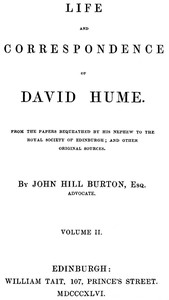
Life and Correspondence of David Hume, Volume 2 — Edition Insights can be approached with a clearer sense of reading commitment from its source measurements: 185,013 words, 13 hr 25 min estimated reading time, and 26 detected text sections.
The text analysis averages about 21.6 words per sentence, while the detected sections provide another way to judge how the source is divided.
Project Gutenberg metadata also associates the work with “Hume, David, 1711-1776,” connecting these edition facts with the source record’s subject description.
Explore this collection
These alternatives are selected using recorded categories and estimated reading time.
About 789 minutes
Ethics
181,297 recorded words. 16 minutes difference from this book's estimate.
View Gutenberg source #71064About 832 minutes
Ethics
191,356 recorded words. 27 minutes difference from this book's estimate.
View Gutenberg source #71249About 755 minutes
Ethics
173,590 recorded words. 50 minutes difference from this book's estimate.
View Gutenberg source #60212Search stored excerpts and compare books → Choose by your preferences →
Choices use stored catalog measurements. Estimates vary with reading speed. A shared category is a catalog label, not a claim that two books have the same argument or literary quality.
Search reads excerpt text stored with this catalog and links to its associated Gutenberg record. The connection is stored in the site database; this tool does not recheck that every excerpt is word-for-word identical to that external record. Excerpt search does not cover every chapter and does not verify historical publication dates.
Catalog snapshot checked: 2026-09-26. Coverage: 94 public books, 94 available source excerpts.
Calculated from edition completeness, EPUB availability, text structure and catalogue metadata. Not a user rating.
Total of 100 points, scaled to a 2.5-5.0 range. Editions with an empty description or a missing EPUB file are not scored.
Public-domain source text
The source text is kept in the dedicated reader, separate from this catalogue record and its commentary.
The volume opens with Hume in his mid-forties, deep in the revision of his History of England and the composition of the Four Dissertations. Burton’s narrative weaves together letters and editorial commentary, giving readers direct access to Hume’s own words on his work and reputation. The correspondence reveals a man acutely aware of his public image, as when he notes the “hard pull” required to secure his embassy secretaryship, and his satisfaction at a salary of £1200 a year “without dedication or application.”
These letters are not merely biographical supplements; they are the primary evidence for Hume’s character and concerns. Burton’s role is that of a curator, selecting and arranging documents to illuminate the philosopher’s later career. The reader is thus invited to read the volume as a documentary history, where the narrative is built from the ground up by the participants themselves.
The excerpts from Hume’s correspondence are the most vivid part of the volume. In a letter announcing his appointment as secretary to the embassy, he writes with a blend of self-deprecation and pride: “in spite of Atheism and Deism, of Whiggism and Toryism, of Scoticism and Philosophy, I am now possessed of an office of credit.” The tone is playful yet pointed, revealing a man who knows his reputation and enjoys defying expectations. He also expresses gratitude to a “certain lady” who interceded with the Duke of Bedford, adding a personal dimension to the political narrative.
These letters are not merely records of events; they are performances. Hume crafts his persona for each correspondent, whether jesting about his philosophical enemies or detailing the “confusions in the court.” The reader should attend to these shifts in register, as they reveal the social intelligence behind the historian’s public face.
Burton does not let the letters speak entirely for themselves. He inserts contextual paragraphs that guide interpretation, often with a critical edge. For instance, after quoting Hume’s letter about his appointment, Burton notes that “it is probable that this appointment was impeded by more difficulties than Hume himself could see.” He then cites a parliamentary complaint about the embassy being “totally of Scotch complexion,” showing the political resistance Hume faced.
Burton also draws on later authorities, such as Lord Brougham, who praised Hume’s “business-like talents” and “capacity for affairs” based on examination of embassy correspondence. This layering of voices—Hume’s, Burton’s, and external commentators—creates a polyphonic text. The reader must navigate between primary source and editorial gloss, a process that mirrors the historian’s own craft.
Though the excerpts focus on diplomatic affairs, the chapter headings remind us that this period was one of intense historical writing. Burton details Hume’s alterations to the History in the direction of “despotic Principles,” with specimens of stylistic changes. The reader is told of Hume’s “elaboration” and his labours on the early part of the history, as well as his intention to write an ecclesiastical history.
These references are tantalizingly brief in the excerpts, but they establish a key theme: Hume’s historical work was never finished. He revised his own text repeatedly, responding to criticism and changing his views. The correspondence likely contains further evidence of this process, and the reader should watch for letters that discuss specific revisions or reactions to his critics.
The volume documents Hume’s extensive network of correspondents and patrons. The letter about his appointment names the Earl of Hertford, the Duke of Bedford, and a mysterious “certain lady,” illustrating the patronage system that enabled his career. Burton also mentions Hume’s acquaintance with Madame de Boufflers, his first intercourse with Rousseau, and his correspondence with Reid.
These relationships were not merely social; they were intellectual and political. Hume’s position as chargé d’affaires involved negotiations on Canada and Dunkirk, matters of state that required diplomatic skill. The excerpts show him dealing with “slippery and evasive ministers,” and Burton’s citation of Lord Brougham confirms that Hume’s despatches were “clearly and ably written.” The reader gains a sense of Hume as a man of affairs, not just a philosopher.
This volume rewards a reader who moves slowly, attending to the interplay between letter and commentary. The excerpts offer only a sample; the full correspondence contains many more such moments. To read it well is to watch a historian constructing his own legacy, one letter at a time.
Reading Burton’s volume, I kept thinking how Hume’s letters feel like a quiet hand on your shoulder—so much living between the lines of policy and friendship. It reminded me of that feeling in The City of God, Volume I — Context and Discussion, where history’s weight turns strangely intimate. Both left me sitting still, not quite ready to close the book.
Create a short personal record of your experience with this book.