About 805 minutes
Life and Correspondence of David Hume, Volume 2 — Edition Insights
Ethics
185,013 recorded words. 27 minutes difference from this book's estimate.
View Gutenberg source #42844
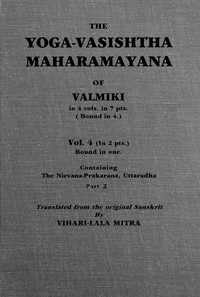
For The Yoga-Vasishtha Maharamayana of Valmiki, Vol. 4 (of 4), Part 2 (of 2) — Story, Setting & Ideas, the stored edition analysis reports 191,356 words, 13 hr 52 min estimated reading time, and 116 detected text sections.
The text analysis averages about 30.3 words per sentence, while the detected sections provide another way to judge how the source is divided.
Project Gutenberg metadata also associates the work with “Religious life -- Hinduism -- Early works to 1800,” connecting these edition facts with the source record’s subject description.
Explore this collection
These alternatives are selected using recorded categories and estimated reading time.
About 805 minutes
Ethics
185,013 recorded words. 27 minutes difference from this book's estimate.
View Gutenberg source #42844About 789 minutes
Ethics
181,297 recorded words. 43 minutes difference from this book's estimate.
View Gutenberg source #71064About 876 minutes
Ethics
201,459 recorded words. 44 minutes difference from this book's estimate.
View Gutenberg source #45422Search stored excerpts and compare books → Choose by your preferences →
Choices use stored catalog measurements. Estimates vary with reading speed. A shared category is a catalog label, not a claim that two books have the same argument or literary quality.
Search reads excerpt text stored with this catalog and links to its associated Gutenberg record. The connection is stored in the site database; this tool does not recheck that every excerpt is word-for-word identical to that external record. Excerpt search does not cover every chapter and does not verify historical publication dates.
Catalog snapshot checked: 2026-09-26. Coverage: 94 public books, 94 available source excerpts.
Calculated from edition completeness, EPUB availability, text structure and catalogue metadata. Not a user rating.
Total of 100 points, scaled to a 2.5-5.0 range. Editions with an empty description or a missing EPUB file are not scored.
Public-domain source text
The source text is kept in the dedicated reader, separate from this catalogue record and its commentary.
The volume opens with chapter CVI, which immediately plunges into a sustained critique of causality, using the metaphor of sweeping away dust to describe the removal of ignorance. The translator, Viharilala Mitra, preserves the verse numbering and the dialogic frame of Vasishtha instructing Rama, a structure that recurs throughout. The text explicitly positions itself as a work to be read repeatedly, comparing itself to the Vedas and claiming to embody both practical and spiritual doctrines. This self-conscious framing is a key feature for first-time readers to note.
The excerpts consistently employ direct address, with Vasishtha speaking to Rama and, by extension, to the reader. Phrases such as “Thus have I said at length, to impress in you the necessity of intense devotion” and “It is from my sympathy for you all, that I propound these doctrines to you” create a sense of ongoing oral instruction. This rhetorical strategy invites the reader into the role of a pupil. The text also anticipates objections, as when it notes that “the evil-minded” may slight the teachings. This built-in rebuttal suggests that the work expects resistance and is designed to overcome it through repetition and reasoned argument.
A striking pattern in the excerpts is the use of concrete metaphors to convey abstract spiritual concepts. Ignorance is likened to “dirt and dross” that must be swept away. The text compares itself to “salt” that seasons other teachings, and disparages those who turn to “unspiritual books” as collecting “burnt ashes after the fire is extinguished.” These metaphors are not merely decorative; they structure the argument by making the intangible tangible. For a first reader, attending to these images can clarify the text’s hierarchy of knowledge: spiritual insight is essential, while worldly pursuits are dismissed as “mere straws.”
The excerpts contain explicit instructions on how the work itself should be used. It is to be “read always, like the recital of the vedas” and studied “with reverence, and rightly explained with diligence.” The text claims to encapsulate the doctrines of Vedanta, Tarka, and Siddhanta, positioning itself as a comprehensive source. This self-promotion is a deliberate rhetorical move, but it also provides a practical reading strategy: the reader is encouraged to engage slowly and repeatedly. The translator’s note about missing text and corrections further underscores that this is a scholarly edition, where textual accuracy matters.
The excerpts present strong philosophical claims, such as the invalidation of cause and effect, and the assertion that “the mind that has gained its peace and tranquility in truth and Divine knowledge, spurns at the state of gods and kings as mere straws.” However, the excerpts are incomplete, and the reasoning behind these claims is only partially visible. For instance, the argument against causality is cut off mid-sentence. A first reader should note that the text builds its case through a series of numbered verses, each adding a layer, but the full dialectic may require consulting the complete volume or earlier parts. The translator’s corrections (e.g., adding “neither” and “not”) indicate that the text’s meaning can hinge on small words.
First-time readers of this volume will benefit from treating it as a spoken discourse rather than a systematic treatise. The verse format, direct address, and recurring metaphors reward slow, attentive reading. The text’s own advice—to read it repeatedly and with reverence—is a practical starting point. Because this is part 2 of volume 4, readers unfamiliar with earlier sections may encounter references to previous teachings; the dialogic frame, however, provides enough context to follow the argument. The editorial corrections remind us that the text has a complex transmission history, but the core instruction remains accessible.
That rainy afternoon, the fourth volume of the Yoga-Vasishtha felt less like philosophy and more like a patient voice asking me to notice how easily I clung to rigid ideas. It made me wonder about the quiet weight of vows, which led me, almost by accident, to The Inevitable Crimes of Celibacy The Vices of Convents and Monasteries, Priests and Nuns — Background and Themes. Different worlds, yet the same shadow of restraint.
Answer a few questions and save a private reflection on this device.