About 1,016 minutes
The City of God, Volume I — Context and Discussion
Ethics
233,578 recorded words. 15 minutes difference from this book's estimate.
View Gutenberg source #45304
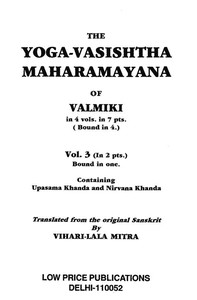
This digital edition of The Yoga-Vasishtha Maharamayana of Valmiki, Vol. 3 (of 4), Part 2 (of 2) — Context and Discussion is described by source-level measurements including 230,055 words, 16 hr 41 min estimated reading time, and 22 detected text sections.
The text analysis averages about 28.9 words per sentence, while the detected sections provide another way to judge how the source is divided.
Project Gutenberg metadata also associates the work with “Religious life -- Hinduism -- Early works to 1800,” connecting these edition facts with the source record’s subject description.
Explore this collection
These alternatives are selected using recorded categories and estimated reading time.
About 1,016 minutes
Ethics
233,578 recorded words. 15 minutes difference from this book's estimate.
View Gutenberg source #45304About 1,049 minutes
Ethics
241,163 recorded words. 48 minutes difference from this book's estimate.
View Gutenberg source #45305About 944 minutes
Ethics
216,991 recorded words. 57 minutes difference from this book's estimate.
View Gutenberg source #45843Search stored excerpts and compare books → Choose by your preferences →
Choices use stored catalog measurements. Estimates vary with reading speed. A shared category is a catalog label, not a claim that two books have the same argument or literary quality.
Search reads excerpt text stored with this catalog and links to its associated Gutenberg record. The connection is stored in the site database; this tool does not recheck that every excerpt is word-for-word identical to that external record. Excerpt search does not cover every chapter and does not verify historical publication dates.
Catalog snapshot checked: 2026-09-26. Coverage: 94 public books, 94 available source excerpts.
Calculated from edition completeness, EPUB availability, text structure and catalogue metadata. Not a user rating.
Total of 100 points, scaled to a 2.5-5.0 range. Editions with an empty description or a missing EPUB file are not scored.
Public-domain source text
The source text is kept in the dedicated reader, separate from this catalogue record and its commentary.
The third volume of Viharilala Mitra's translation of the Yoga-Vasishtha opens the Nirvána Prakarana, or Book on Ultimate Extinction, with a series of chapters that immediately establish a dual focus: metaphysical inquiry and narrative illustration. Chapter I sets the scene with a description of evening and the breaking of an assembly, a framing device that recurs throughout the text. The translator's footnotes, such as the reference to Patanjali's definition of Samádhi as 'the forgetting of one's self in the object of his meditation,' reveal an effort to anchor the Sanskrit concepts in recognizable philosophical terminology.
The excerpts show a text that moves between abstract reasoning—such as the enumeration of thirty-one 'rules' about erroneous dreams and the nature of reality—and concrete stories, like the tale of the mendicant Jívata, whose lingering desire causes him to wander through many births. This interplay between doctrine and parable is a structural hallmark of the work, though the excerpts provide only fragments of the larger narrative arc.
The Project Gutenberg record assigns this volume to the subjects 'Religious life -- Hinduism -- Early works to 1800' and 'Hinduism -- Doctrines -- Early works to 1800.' While these categories are not inaccurate, the excerpts suggest a more specific emphasis. The text is not a general manual of religious practice but a sustained philosophical dialogue aimed at achieving nirvána or ultimate extinction. The chapter titles—'On the perfect calm and composure of the mind,' 'On the unity and Universality of Brahma,' 'Ascertainment of True knowledge'—indicate a preoccupation with epistemology and metaphysics rather than ritual or ethics.
Moreover, the translator's footnotes occasionally introduce Christian parallels, as when he glosses a passage about desire with 'the lord says in the Gospel, He that loveth anything more than me, is not worthy of me.' This interpretive layer, while not part of the original Sanskrit, shapes how the text is presented to an English-speaking audience. Readers should be aware that the catalog subjects provide a broad container, but the work's core is a rigorous, often paradoxical exploration of the nature of reality and the self.
The excerpts reveal several recurring motifs. One is the use of dream and illusion as central explanatory metaphors. The text enumerates 'rules of the erroneous dream,' asserting that 'the erroneous dream though it appears as real is in fact unreal' and that 'by passing from one error to another error... one firm faithful being comes out.' This language suggests a progressive epistemology where truth is approached through the systematic negation of false appearances.
Another pattern is the catalogue of impossible objects—'fire burning in the water,' 'cities exist in vacuity,' 'lotus in a stone'—used to illustrate the power of erroneous perception. These examples are not merely decorative; they function as logical tools to destabilize the reader's assumptions about what is possible. The text also employs animal imagery, such as the 'stray deer falls into the pit repeatedly for green grass' to describe ignorant attachment. These recurring figures give the philosophical argument a concrete, almost poetic texture.
One of the most substantial excerpts is the beginning of Chapter LXII, which introduces the story of the mendicant Jívata. This narrative is explicitly offered as an illustration of 'the transmigration of the soul in various births, according to the variety of its insatiable Desire.' The mendicant, despite his advanced practice of Samádhi, is described as having 'fostered some desire in his mind,' which then causes his wandering. The text thus uses a cautionary tale to dramatize a philosophical point: even advanced practitioners remain vulnerable to subtle attachments.
The translator's footnote expands the application: 'This story applies to all men, who are in some way or other devoted to some profession for acquiring the necessaries of life.' This interpretive move broadens the story's relevance beyond the monastic context. However, the excerpt breaks off before the narrative concludes, so the reader cannot know how Jívata's journey resolves. The incomplete state of the excerpt underscores the importance of reading the full text to understand how such stories function within the larger argumentative structure.
Readers approaching this volume should be prepared for a text that demands close attention to both its abstract reasoning and its narrative interludes. The translator's footnotes, while occasionally anachronistic, provide a useful bridge for those unfamiliar with Sanskrit philosophical terms. Because the excerpts are fragmentary, it is advisable to read the work sequentially, noting how each chapter builds on the previous one. The volume's length—over 230,000 words—means that patience is required, but the reward is a detailed encounter with a major work of Indian philosophy in a Victorian-era translation that itself has become a historical document.
Reading the story of Jívata’s slow disentangling from ignorance, I remembered sitting with my grandfather’s old copy of A Review of Edwards's "Inquiry into the Freedom of the Will" — Text and Context, where the weight of choice felt equally vast. Both books left me staring out a window, not seeking answers, just letting the questions settle. That unhurried silence afterward was the real lesson.
Save your reaction, strongest insight, and memorable passage.