About 1,001 minutes
The Yoga-Vasishtha Maharamayana of Valmiki, Vol. 3 (of 4), Part 2 (of 2) — Context and Discussion
Ethics
230,055 recorded words. 15 minutes difference from this book's estimate.
View Gutenberg source #46531
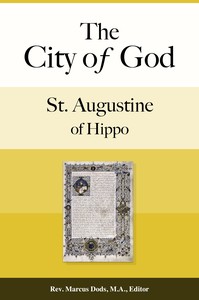
The source record for The City of God, Volume I — Context and Discussion measures this digital text at 233,578 words, 16 hr 56 min estimated reading time, and 26 detected text sections.
The text analysis averages about 34.3 words per sentence, while the detected sections provide another way to judge how the source is divided.
Project Gutenberg metadata also associates the work with “Apologetics -- Early works to 1800,” connecting these edition facts with the source record’s subject description.
Explore this collection
These alternatives are selected using recorded categories and estimated reading time.
About 1,001 minutes
Ethics
230,055 recorded words. 15 minutes difference from this book's estimate.
View Gutenberg source #46531About 1,049 minutes
Ethics
241,163 recorded words. 33 minutes difference from this book's estimate.
View Gutenberg source #45305About 944 minutes
Ethics
216,991 recorded words. 72 minutes difference from this book's estimate.
View Gutenberg source #45843Search stored excerpts and compare books → Choose by your preferences →
Choices use stored catalog measurements. Estimates vary with reading speed. A shared category is a catalog label, not a claim that two books have the same argument or literary quality.
Search reads excerpt text stored with this catalog and links to its associated Gutenberg record. The connection is stored in the site database; this tool does not recheck that every excerpt is word-for-word identical to that external record. Excerpt search does not cover every chapter and does not verify historical publication dates.
Catalog snapshot checked: 2026-09-26. Coverage: 94 public books, 94 available source excerpts.
Calculated from edition completeness, EPUB availability, text structure and catalogue metadata. Not a user rating.
Total of 100 points, scaled to a 2.5-5.0 range. Editions with an empty description or a missing EPUB file are not scored.
Public-domain source text
The source text is kept in the dedicated reader, separate from this catalogue record and its commentary.
The opening of The City of God, Volume I is framed by a specific historical crisis: the Gothic sack of Rome under Alaric in 410 CE. Augustine states directly that pagan worshippers attributed this calamity to the Christian religion, and that this “kindled my zeal for the house of God” and prompted the work. The editor’s preface reproduces Augustine’s own account of the work’s origin, noting that the project stretched over several years due to other obligations. This immediate, polemical context shapes the entire first book, which censures pagans for blaming Christianity while their own gods had long failed to protect Rome.
The opening book is not a general treatise but a targeted response to a contemporary accusation. Augustine’s language is combative: he speaks of the pagans’ “bitterness and acerbity” and their blasphemy against the true God. The editor’s preface clarifies that the work was composed over several years, with interruptions from other affairs. This suggests that the reader should expect a layered argument, where the initial defensive posture gradually expands into a broader philosophical and theological framework. The excerpts show that Augustine does not merely rebut the charge; he turns it into an occasion to examine the moral and spiritual condition of Rome under its traditional gods.
In the later excerpts, Augustine engages extensively with the Roman scholar Varro, who distinguished three kinds of theology: mythical, natural (or physical), and civil. Augustine uses Varro’s own categories to expose contradictions in pagan worship. He quotes Varro’s division of soul into three grades—life, sensation, and mind—and notes that Varro identifies the highest grade with God and, in humans, with Genius. Augustine then turns this against Varro: if stones and earth are like bones and nails, they lack intelligence; if they are said to have intelligence because they are part of a whole, then human bones and nails would also be gods. This logical dissection is typical of Augustine’s method: he adopts an opponent’s framework and pushes it to absurdity.
Augustine devotes a sustained passage to the claim that the earth is a goddess because the world-soul pervades it. He counters with a concrete observation: the earth is a “mighty mass among the elements, and the lowest part of the world.” If fruitfulness makes it divine, why not deify farmers who cultivate it? He then notes that Varro himself, in his book on select gods, posits three grades of soul, with the earth corresponding to the lowest, lifeless grade. Augustine’s argument is not merely theological but rhetorical: he contrasts the evident reality of human soul and intelligence with the absurdity of worshipping insensate matter. The passage exemplifies how Augustine moves from specific pagan claims to broader philosophical refutation.
The excerpts reveal a clear structural arc. The first books (I–V) address the immediate historical accusation and argue that Rome’s empire came from the true God, not pagan gods. Books VI–X critique pagan theology, especially Varro’s civil theology and the Platonic demonology. From Book XI onward, Augustine turns to the origin, progress, and destinies of the two cities—the earthly and the heavenly. The reader should note that the work is not a single sustained argument but a series of engagements that broaden in scope. The early books are more polemical and tied to recent events; the later books become more speculative and doctrinal. This shift in tone and subject matter is essential for understanding Augustine’s overall project.
Because the excerpts cover only the first half of the work (Books I–XIII), the reader should be aware that the second volume continues with the later books on the two cities. Augustine’s method of quoting and then dissecting pagan authorities means that the text is dense with references to Roman history, philosophy, and religion. A first-time reader may benefit from reading the editor’s preface and the first book carefully to grasp the polemical context, then noting how Augustine’s argument expands from a specific event to a universal theology of history.
I have spent many quiet evenings with Augustine’s City of God, watching him dismantle Rome’s old certainties, and it always leaves me thinking about how fragile our earthly shelters truly are. Lately, I found myself recalling that same ache of impermanence while turning pages of The Yoga-Vasishtha Maharamayana of Valmiki, Vol. 2 (of 4), Part 2 (of 2) — Inside the Classic—a gentler voice, yet somehow whispering the very same truth about the vanity of clinging to any material kingdom.
Your answers remain private and are stored only in this browser.