About 264 minutes
The Truth About Jesus : Is He a Myth? Illustrated — Context and Discussion
Ethics
60,491 recorded words. 7 minutes difference from this book's estimate.
View Gutenberg source #45068
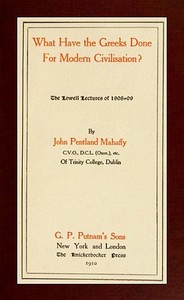
For What Have the Greeks Done for Modern Civilisation? — Themes and Context, the stored edition analysis reports 62,243 words, 4 hr 31 min estimated reading time, and 10 detected text sections.
The text analysis averages about 32.1 words per sentence, while the detected sections provide another way to judge how the source is divided.
Project Gutenberg metadata also associates the work with “Civilization,” connecting these edition facts with the source record’s subject description.
Explore this collection
These alternatives are selected using recorded categories and estimated reading time.
About 264 minutes
Ethics
60,491 recorded words. 7 minutes difference from this book's estimate.
View Gutenberg source #45068About 288 minutes
Ethics
66,017 recorded words. 17 minutes difference from this book's estimate.
View Gutenberg source #36795About 289 minutes
Ethics
66,454 recorded words. 18 minutes difference from this book's estimate.
View Gutenberg source #35958Search stored excerpts and compare books → Choose by your preferences →
Choices use stored catalog measurements. Estimates vary with reading speed. A shared category is a catalog label, not a claim that two books have the same argument or literary quality.
Search reads excerpt text stored with this catalog and links to its associated Gutenberg record. The connection is stored in the site database; this tool does not recheck that every excerpt is word-for-word identical to that external record. Excerpt search does not cover every chapter and does not verify historical publication dates.
Catalog snapshot checked: 2026-09-26. Coverage: 94 public books, 94 available source excerpts.
Calculated from edition completeness, EPUB availability, text structure and catalogue metadata. Not a user rating.
Total of 100 points, scaled to a 2.5-5.0 range. Editions with an empty description or a missing EPUB file are not scored.
Public-domain source text
The source text is kept in the dedicated reader, separate from this catalogue record and its commentary.
Mahaffy opens his 1908 Lowell Lectures with a defensive tone, countering what he perceives as American indifference to Greek studies. He claims that Greek thinking remains supreme even in science, and that modern builders have not matched Greek mechanical feats. The preface reveals his surprise at finding more support for classical education in America than he expected, citing employers who value liberal education for its practical benefits. This personal, almost conversational voice sets the stage for a series of arguments that blend scholarly assertion with popular appeal.
Mahaffy devotes a notable passage to Greek music theory, arguing that the Greeks attributed direct moral effects to musical scales. He explains the Pythagorean discovery of numerical ratios in concords—octaves, fifths, fourths—and notes that the Greeks did not accept the major third as a concord. He then makes a surprising leap: he suggests that studying Handel, Corelli, or Palestrina may strengthen the mind, while Chopin, Verdi, or Beethoven may foster the vices of modern society. This claim is based on the Greek view that music affects character, but Mahaffy offers no evidence from the excerpts that the Greeks themselves made such specific comparisons. The argument is speculative, yet it reveals his willingness to apply ancient theories to contemporary debates.
Turning to household arts, Mahaffy argues that Greek ideas underpin modern furniture and decoration. He notes that no Greek town of the best epoch has been unearthed, but points to Pompeii and Herculaneum as evidence of Greek influence through the port of Puteoli. He observes that Hellenistic artists incorporated Egyptian motifs like the ibis and crocodile, just as French Empire style later borrowed from Egypt. The wall decorations and furniture from these Roman towns, he claims, are essentially Greek in kind. This section shows Mahaffy's method: he uses archaeological evidence to trace cultural transmission, but acknowledges the limits of the record. His tone is confident, yet he admits that the evidence is indirect.
Mahaffy's preface reveals his initial belief that Greek studies were held in contempt in America, replaced by a hurried, practical education. But his visit corrected this impression. He reports that public opinion is not satisfied with the reign of modern science, and that even factory employers find liberal education makes workers more intelligent. This personal anecdote frames the entire lecture series as a response to a perceived crisis. Mahaffy's voice is that of a seasoned academic, but he also shows a willingness to revise his views based on experience. The passage is notable for its direct address to the audience and its implicit defense of the humanities.
Mahaffy's lectures are best approached as a series of arguments rather than a systematic history. He moves from music to furniture to education, each time using Greek examples to challenge modern assumptions. Readers should note his tendency to extrapolate from limited evidence, especially in the music section, and his reliance on personal observation in the education debate. The book rewards those interested in early 20th-century defenses of classical education and the rhetorical strategies used to assert Greek influence.
I remember sitting with What Have the Greeks Done, feeling Mahaffy’s quiet fury at our forgetfulness. It reminded me of an old notebook where I’d underlined something about permanence—how a single proof of existence could linger like a warm stone. Later, Immortality proved by the testimony of sense — A Reader’s Guide stirred the same ache: two voices insisting that what we touched once still matters, even if we look away.
Build a private reading journal entry for this title.