About 832 minutes
The Yoga-Vasishtha Maharamayana of Valmiki, Vol. 4 (of 4), Part 2 (of 2) — Story, Setting & Ideas
Ethics
191,356 recorded words. 44 minutes difference from this book's estimate.
View Gutenberg source #71249
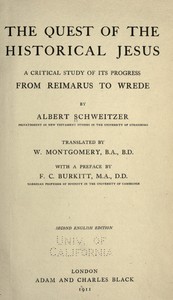
For The quest of the historical Jesus — Edition Insights, the stored edition analysis reports 201,459 words, 14 hr 36 min estimated reading time, and 31 detected text sections.
The text analysis averages about 23.2 words per sentence, while the detected sections provide another way to judge how the source is divided.
Project Gutenberg metadata also associates the work with “Jesus Christ -- Historicity,” connecting these edition facts with the source record’s subject description.
Explore this collection
These alternatives are selected using recorded categories and estimated reading time.
About 832 minutes
Ethics
191,356 recorded words. 44 minutes difference from this book's estimate.
View Gutenberg source #71249About 944 minutes
Ethics
216,991 recorded words. 68 minutes difference from this book's estimate.
View Gutenberg source #45843About 805 minutes
Ethics
185,013 recorded words. 71 minutes difference from this book's estimate.
View Gutenberg source #42844Search stored excerpts and compare books → Choose by your preferences →
Choices use stored catalog measurements. Estimates vary with reading speed. A shared category is a catalog label, not a claim that two books have the same argument or literary quality.
Search reads excerpt text stored with this catalog and links to its associated Gutenberg record. The connection is stored in the site database; this tool does not recheck that every excerpt is word-for-word identical to that external record. Excerpt search does not cover every chapter and does not verify historical publication dates.
Catalog snapshot checked: 2026-09-26. Coverage: 94 public books, 94 available source excerpts.
Calculated from edition completeness, EPUB availability, text structure and catalogue metadata. Not a user rating.
Total of 100 points, scaled to a 2.5-5.0 range. Editions with an empty description or a missing EPUB file are not scored.
Public-domain source text
The source text is kept in the dedicated reader, separate from this catalogue record and its commentary.
Albert Schweitzer's The Quest of the Historical Jesus (1906, translated 1910) is not a biography of Jesus but a history of the biographical enterprise itself. Schweitzer traces how scholars from Reimarus to Wrede constructed Jesuses that reflected their own theological and philosophical commitments. The catalog subjects—'Jesus Christ -- Historicity' and 'Jesus Christ -- Biography -- History and criticism'—accurately frame the work, but the excerpts reveal a more specific focus: Schweitzer is particularly concerned with how eschatology was handled. He devotes sustained attention to figures like Weiffenbach and Colani, dissecting their attempts to isolate 'authentic' sayings from later apocalyptic additions. The book's structure, with chapters on individual scholars and schools, underscores its argument that the 'historical Jesus' is a product of critical method as much as ancient evidence.
The excerpts show that Schweitzer treats eschatology as the decisive issue dividing scholars. He criticizes Weiffenbach for taking as his standard a 'colourless, unreal figment of theology'—a sanitized expectation of the Second Coming stripped of Jewish apocalyptic features. Schweitzer argues that this approach leads to arbitrary excision of material: the Last Supper saying is dismissed as 'Chiliastic-Capernaitic,' and Jesus as world-judge is deemed foreign to his thought-world. The debate is not merely historical but methodological: how much of the Gospel eschatology belongs to Jesus, and how much to later Christian communities? Schweitzer's own position, hinted at in chapter titles like 'Thoroughgoing Scepticism and Thoroughgoing Eschatology,' emerges through his critique of others' inconsistencies.
Schweitzer organizes his material chronologically by scholar or school, from Reimarus through the rationalists, Strauss, Renan, and the 'liberal' lives. The table of contents lists twenty chapters plus an index, moving from 'The Problem' to 'Results.' This structure itself makes an argument: each successive 'Life of Jesus' is shown to be conditioned by its era's intellectual currents. The excerpts do not reveal Schweitzer's final conclusions, but the preface by F. C. Burkitt notes the 'protean and kaleidoscopic figure' of the historical Jesus, a theme Schweitzer likely develops. The work is a critical study of progress—but progress toward what? The excerpts suggest Schweitzer doubts that any single portrait can claim finality.
W. Montgomery's translation, with a preface by F. C. Burkitt, brought Schweitzer's German work to an English audience in 1910. The excerpts include Burkitt's remark that the book 'sets before them, as no other book has ever done, the history of the struggle' of modern intellects with Jesus's personality. This framing emphasizes the work's historiographic value over its theological conclusions. The second English edition (1911) suggests the translation found an audience. Montgomery, a B.A. and B.D., renders Schweitzer's dense prose into readable English, though the excerpts retain technical terms like παλιγγενεσία (regeneration) untransliterated. Readers should note that the text is a translation of a 1906 original, and later scholarship has superseded some of Schweitzer's analyses.
Schweitzer's book rewards readers who approach it as a history of ideas rather than a guide to Jesus's life. Pay attention to how each scholar's presuppositions—about miracle, prophecy, and eschatology—shape their reconstruction. The excerpts show Schweitzer's method: close reading of arguments, identification of logical flaws, and a relentless focus on the eschatological problem. For those new to the field, Burkitt's preface offers a helpful orientation. The work remains a landmark in New Testament studies, not for its conclusions but for its demonstration that every 'historical Jesus' is also a portrait of the historian.
Reading how Schweitzer’s scholars molded Jesus to their own anxieties, I remembered sitting in my grandmother’s study, feeling the same quiet unease while turning pages of What Have the Greeks Done for Modern Civilisation? — Themes and Context. Both books whisper the same truth: we never truly meet the past, only our own reflection staring back, asking who we hoped to find there.
Answer a few questions and save a private reflection on this device.